 Alliance Equity Research
US Lime’s Texas Kiln Nears Commissioning as Higher Costs Offset Revenue Growth
United States Lime & Minerals increased third-quarter revenue through higher prices and shipment volumes, while diesel costs and startup inefficiencies at its new Texas kiln reduced profit. Management expects final commissioning in the fourth quarter, when depreciation on the new equipment will begin. The company has ample cash to complete the project, but construction delays and early signs of slower Texas housing could limit demand for its output. Earnings improvement will require reliable production, lower unit costs and sufficient sales to earn a return on the investment.

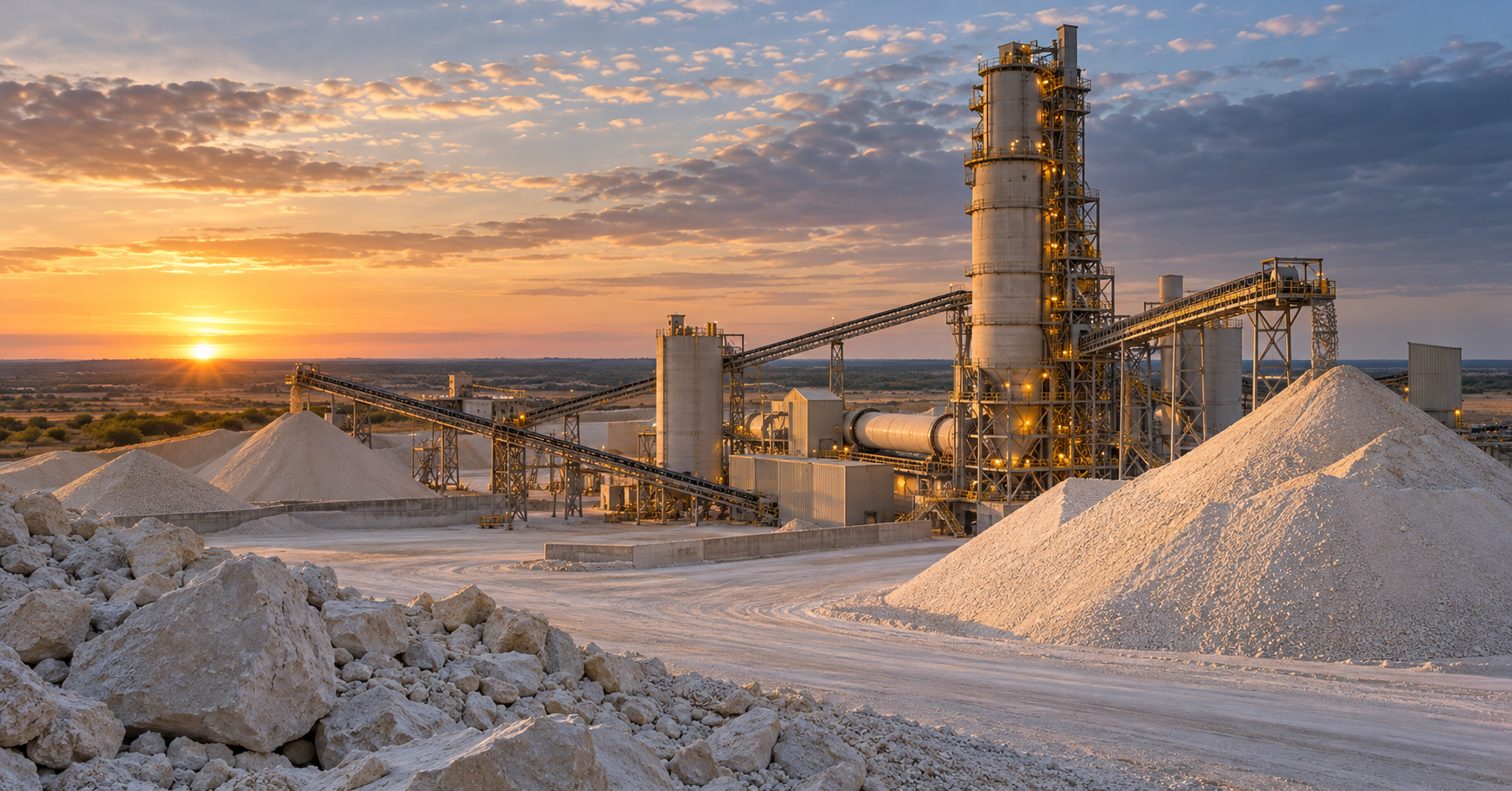
United States Lime & Minerals (Nasdaq: USLM) reported third-quarter results on October 30, 2026, with revenue rising 4.1% to $106.2 million from $102.0 million a year earlier. Higher prices and shipment volumes supported sales, but production and delivery costs increased faster. The result was lower profit during a quarter in which its new Texas kiln began producing intermittently.
The new kiln is approaching commissioning as construction demand weakens. Steadier production could reduce startup costs, while slower customer activity could limit sales from the expanded plant. USLM can fund the remaining work from its existing resources; the near-term earnings contribution will depend on reliable production, lower unit costs and demand.
Lime demand spans construction and industry
USLM extracts limestone and processes it into products used in construction and industrial applications. Quicklime is made by heating high-calcium limestone in kilns. It is also processed into hydrated lime and lime slurry, giving customers different forms of lime for soil treatment, manufacturing and environmental applications.
In construction, lime improves the workability and load-bearing characteristics of poor soils, and hydrated lime is used in asphalt pavements. Orders depend on projects reaching the stage when those materials are needed. Delays to road or building work can postpone shipments even when the project remains planned.
Steel producers use quicklime to remove impurities during refining. USLM also supplies environmental, industrial and other customers, giving it several sources of demand. Their performance can diverge, as stronger steel demand and weaker construction activity did this quarter.
The annual report identifies energy as the principal variable cost and notes that freight can be substantial relative to product value. Fuel-efficient production and proximity to customers help control the cost of supplying each ton. Higher diesel prices can erode the benefit of selling-price increases by making deliveries more expensive.
Higher costs reduced margins
The quarterly filing attributes revenue growth to average selling prices rising 2.5% and shipment volumes increasing 1.6%. Dollar amounts in the following table are in millions.
| Three months ended September 30 | 2025 | 2026 | Change |
|---|---|---|---|
| Revenue | $102.02 | $106.19 | +4.1% |
| Cost of revenues | $49.83 | $55.42 | +11.2% |
| Gross profit | $52.19 | $50.77 | −2.7% |
| Operating profit | $46.26 | $44.70 | −3.4% |
| Net income | $38.78 | $38.04 | −1.9% |
Cost of revenues increased $5.59 million against only $4.17 million of additional revenue. Gross margin consequently fell to 47.8% from 51.2%, a contraction of approximately 3.35 percentage points. Management attributed the pressure primarily to higher transportation and fuel costs, particularly diesel, and inefficiencies integrating the Texas kiln into existing operations.
Selling, general and administrative costs rose 2.3%, from $5.93 million to $6.07 million. Operating profit fell $1.56 million. Higher other income, principally from interest on cash, offset $0.38 million of that decline, and lower tax expense offset another $0.44 million. Net income consequently declined by $0.74 million, less than the reduction in operating profit.
The Texas kiln’s operating contribution
USLM’s 2025 annual report described the Texas expansion as an opportunity to improve fuel efficiency. In its July 29 second-quarter release, management expected the kiln to come online during the summer. It began producing intermittently in the third quarter, with final commissioning now expected in the fourth quarter.
USLM will begin depreciating the kiln and related equipment after final commissioning, according to the September filing. Bringing the plant into steadier production could reduce the inefficiencies already affecting costs. The new depreciation expense will also enter reported operating profit, so the net earnings benefit will depend on the size of those operating gains.
The approximately $65 million investment must generate cash and an adequate return over its operating life. Higher throughput and lower fuel use could improve that return if customers buy the additional output at profitable delivered prices. USLM has not quantified the expected savings, depreciation charge or incremental earnings contribution, leaving the size of the benefit uncertain.
Construction demand weakened in the quarter
In the second-quarter release, management reported growth from construction and steel customers and expected data-center projects to support construction demand. By the third quarter, lower construction demand was offsetting part of the increase from steel. The change leaves the expanded plant facing a less favorable construction backdrop than management described in July.
Management remains optimistic about construction over time, but cited delays to large projects, including permitting issues, and early signs of slower Texas residential activity. Some delayed work could produce shipments in later periods; sustained housing weakness would reduce the pace of new demand. USLM has not quantified the contribution of either factor, so the release provides limited evidence about how quickly construction volumes could recover.
Cash flow covers a larger investment outlay
For the first nine months, operating cash flow increased 3.3% to $123.3 million from $119.4 million, while capital expenditure rose to $50.2 million from $42.8 million. Operating cash less gross purchases of property, plant and equipment was consequently $73.1 million, down from $76.6 million. This calculation excludes asset-sale proceeds and shows that higher operating cash did not fully offset the larger investment outlay.
The cash-flow statement includes a $13.5 million add-back for deferred tax expense, which reduced earnings without an equivalent current-period cash payment. Changes in operating assets and liabilities used $18.1 million of cash, as increased receivables and inventory outweighed offsets elsewhere. Cash generation therefore benefited from tax timing while customer collections and other operating balances absorbed funds.
At September 30, cash totaled $439.2 million and no borrowings were outstanding. USLM had incurred $61.0 million of the approximately $65 million project estimate and paid $60.4 million in cash. Those resources give the company ample capacity to complete the kiln and manage fluctuations in demand.
Stable kiln operation accompanied by recovery from the third quarter’s 47.8% gross margin would provide evidence that the expansion is improving earnings after depreciation. If margins remain weak once startup disruption has eased, diesel costs, pricing and the volume available to fill the plant would become the main constraints on its contribution.
This material is provided for informational and educational purposes only and does not constitute investment advice or a recommendation to buy or sell any security.
Companies Discussed
About AER Insights
Alliance Equity Research publishes timely insights on company-specific developments, industry trends, capital markets activity, and emerging investment themes across global public markets, with a particular focus on undercovered companies, sectors, and developments that often receive limited attention from mainstream financial research. Our analysis focuses on the financial, strategic, and valuation implications behind the headlines, using company disclosures, filings, market data, and sector context to help investors understand what matters, why it matters, and what to watch next.
Get AER Insights by Email
Receive new AER Insights and research updates in your inbox.
Related Insights
 Biotechnology & Healthcare
INOVIO’s Voceryq Approval Shifts Attention to Patient Uptake, Competition and Launch Funding
INOVIO’s first approved DNA medicine offers a new approach to reducing airway surgery. Commercial adoption will depend on its treatment profile, reimbursement and competition, while management’s disclosed cash runway overlaps the planned launch quarter and continuing clinical obligations extend beyond it.
 Energy
Capital Clean Energy Carriers’ Larger Fleet Lifts Earnings as 2027 Vessel Payments Approach
CCEC’s third-quarter revenue and earnings increased as new ships entered service. Large payments in early 2027 bring the funding plan into focus. Existing charters and operating cash provide support, while borrowing terms and exposure to market-linked rates shape the cash ultimately retained for shareholders.
 Mining & Critical Minerals
FireFly’s Cash Gives Green Bay Financing Flexibility Ahead of a 2027 Investment Decision
FireFly’s A$337.1 million cash balance strengthens its position as Green Bay approaches feasibility and construction financing. For shareholders, the benefit depends on the remaining capital requirement and funding terms. The larger mine plan offers more production, accompanied by additional investment and a longer development programme.
 Mining & Critical Minerals
Serabi’s Coringa Permit Delay Defers the Returns From Its Expanded Processing Plant
Serabi Gold’s production cut shifts attention from building capacity to securing permission to use it. Cash provides a cushion, but delayed Coringa ore deliveries and weaker Palito grades reduce the near-term output available to recover development spending and support shareholder returns.
About Alliance Equity Research
Alliance Equity Research publishes independent and company-sponsored equity research on undercovered, emerging, and high-potential public companies globally. Our analyst-built, model-backed research combines fundamental business analysis, financial forecasting, and valuation.
Email: info@alliancekp.com · Website: https://allianceequityresearch.com
For detailed company research, financial models, or coverage inquiries, contact our research team.
Research commentary for informational purposes. This document does not constitute personalized investment advice or a Buy, Hold, or Sell recommendation. For important disclosures, including information about research sponsorship and potential conflicts of interest, visit allianceequityresearch.com/disclosures.