 Alliance Equity Research
Serabi’s Coringa Permit Delay Defers the Returns From Its Expanded Processing Plant
Serabi Gold’s production cut shifts attention from building capacity to securing permission to use it. Cash provides a cushion, but delayed Coringa ore deliveries and weaker Palito grades reduce the near-term output available to recover development spending and support shareholder returns.
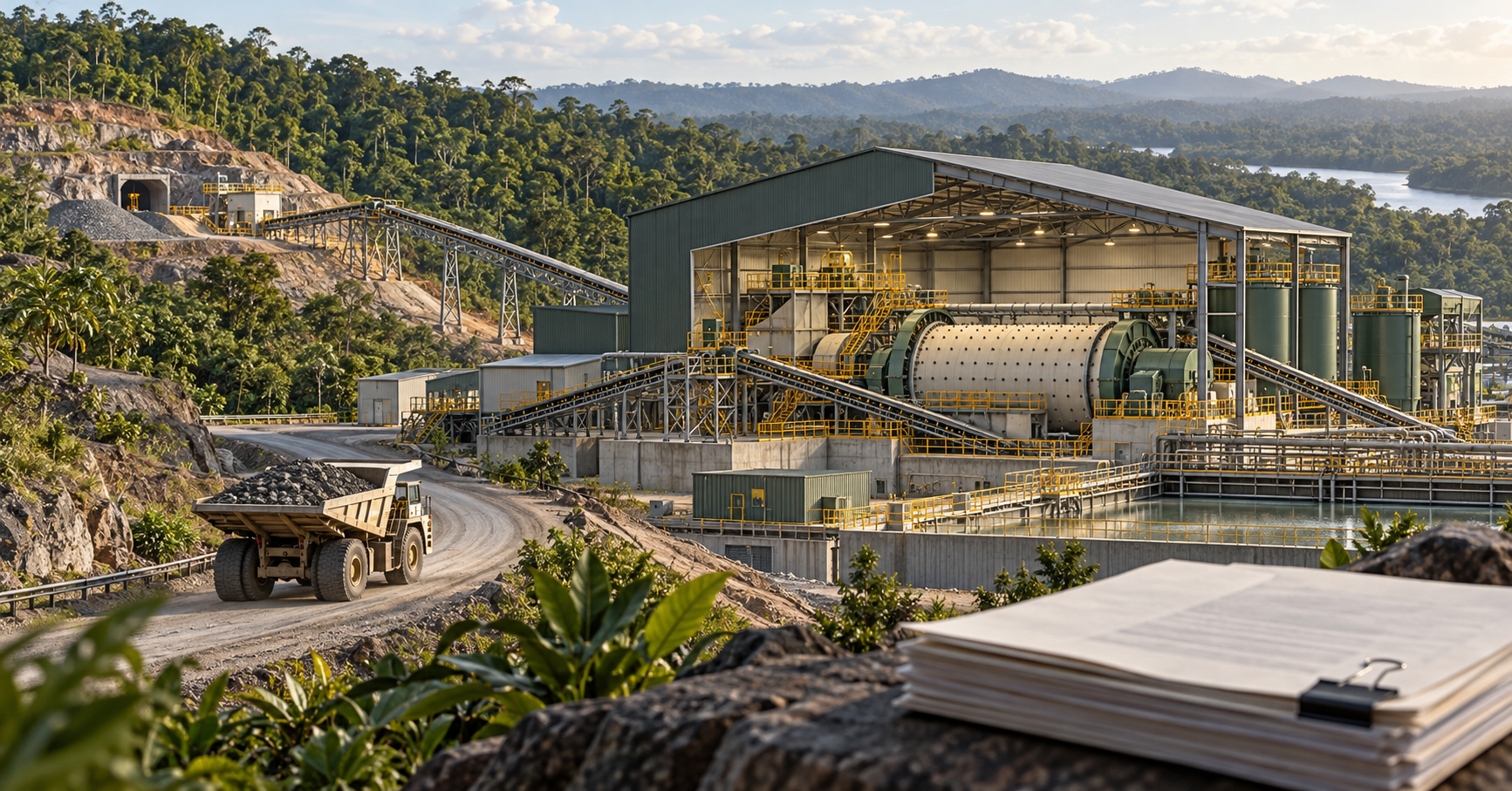
Serabi Gold cut its 2026 production outlook on 21 October, replacing a target above 53,000 ounces with output similar to 2025. Its fourth processing mill is in final commissioning, but Coringa’s outstanding permits prevent the planned increase in ore deliveries. AER’s assessment is that the expansion’s financial benefit has been deferred, while the existing operation remains exposed to a nearer licensing deadline.
Two mines depend on one processing plant
Serabi operates underground gold mines in Brazil’s Pará state. Its 2025 annual report describes a shared processing strategy: ore from Coringa is upgraded before being trucked roughly 200 kilometres to the Palito Complex. The business sells gold bullion and gold-bearing concentrate, with smaller copper and silver revenue. Cash generation depends on ore volumes, grade, meaning gold content per tonne, recovery of that gold, selling prices and operating costs.
An ore sorter at Coringa separates waste using differences in the material’s physical characteristics. Removing waste before trucking and milling reduces the tonnes handled for a given quantity of gold. Sharing the Palito plant also avoids constructing a separate full processing operation at Coringa, reducing the capital needed to develop the mine.
The additional ball mill, which grinds ore for gold extraction, was designed to lift processing capacity from 650 to about 900 tonnes a day. That is approximately 38% more capacity, for an estimated $5 million investment funded from existing cash. This is a relatively modest plant investment that could accommodate more ore from the existing mines. Its financial return depends on permitted ore supply, grade and recovery, rather than capacity alone.
The revised outlook removes a large fourth-quarter increase
The 23 July operational update retained production above 53,000 ounces, conditional on Coringa approvals. By the 22 September interim results, management had made the dependency explicit: the annual ore-transport allowance needed to double from 100,000 to 200,000 tonnes, or the full mining concession needed to arrive, allowing more ore through the expanded plant.
The old target required more than 18,900 ounces in Q4 after the 34,057 ounces produced in January–September. That would have been over 72% above Q3’s 11,008 ounces. The revised outlook removes that expected increase.
| Production measure | Earlier outlook | Revised outlook illustrated at 2025 output |
|---|---|---|
| Full-year 2026 gold production | More than 53,000 oz | About 44,200 oz |
| Implied fourth-quarter output | More than 18,900 oz | About 10,100 oz |
Output around last year’s level would be roughly 17% below the former 53,000-ounce threshold. The cash effect would depend on gold prices and the costs avoided on unproduced ounces, but fewer ounces would be available to absorb fixed site and corporate expenses. Shareholders are therefore facing a lower near-term return on the development programme, even though much of the supporting infrastructure is in place.
The constraint affects the larger current contributor: Coringa supplied approximately 74% of Q3 gold production. At Palito, weaker grades reduced output, although management expects higher-grade G3 material to help in Q4. Better Palito grades could support group production, but the scale of Coringa’s contribution makes continuity there central to the near-term cash outlook.
Continuing production and expanding production require different permissions
Coringa’s trial mining licence expires on 29 January 2027. The September disclosure also warned that its annual tonnage limit could constrain operations earlier. Authorisation must therefore cover both the operating period and enough ore tonnage to sustain deliveries. Extending the expiry date alone would leave the volume constraint in place; a larger allowance would determine whether deliveries could expand.
The longer-term route described in September requires land-use approval from Brazil’s land agency and approval of an Indigenous impact study by the federal Indigenous affairs agency before environmental operating permission. Serabi said in October that it can bypass an installation-licence stage and apply directly for the operating licence after those approvals. Management identifies that licence or a higher trial-licence allowance as the route to additional ore deliveries; the final mining concession follows the operating licence. The shorter sequence reduces the number of remaining steps, but approval timing remains unresolved.
Stronger gold prices have supported cash, while costs have risen
Serabi’s first-half financial statements show revenue of $100.1 million, up from $62.5 million a year earlier. Gold sales rose about 6%, while the average realised gold price increased 52% to $4,687 an ounce. Higher selling prices supplied much of the revenue improvement.
Costs moved higher too. The interim results reported all-in sustaining cost of $2,682 per produced ounce, compared with $1,792 in the first half of 2025. This company-defined measure includes sustaining expenditure beyond direct production costs. Management attributed pressure to Coringa’s ramp-up and one-time administrative charges. Higher production could spread some costs more widely, while energy, consumables and currency movements would continue to influence profitability.
The cash-flow statement shows that operations generated $40.1 million in the first half. Net investing outflows, including mine development, equipment and exploration, absorbed $18.8 million, leaving $21.3 million before financing flows. Working-capital movements helped operating cash generation, but the business nevertheless funded its investment programme internally during that period.
Cash at 30 September was $63.2 million, against $65.7 million in June, after a $5.1 million July dividend. Another $3.4 million from September bullion sales arrived on 1 October. Serabi reports no bank debt; the June statements separately recorded $2.7 million of lease liabilities.
Cash cushions the delay; authorised ore supply determines the growth return
Management’s June financial statements included forecasts showing sufficient resources to continue operating even if Coringa production were suspended, with discretionary spending available to be reduced. Those forecasts support the view that the immediate issue is the timing and level of future cash generation. They do not establish how much cash would remain available for growth investment or shareholder distributions during a prolonged interruption.
Management expects capital expenditure to fall in 2027 following this year’s underground development, potentially improving cash retention. An alternative source of plant feed is São Chico, whose possible restart was discussed in the annual report. Its ore is less suitable for sorting, and restarting remains subject to economic assessment and licence renewal. It provides an option, not committed replacement output for Coringa.
AER sees a funded plant expansion with a credible route to higher production, but less near-term cash generation than the former volume outlook implied. Authorisation covering sufficient time and ore tonnage to maintain Coringa deliveries would protect most of the current production base. Permission for additional deliveries would allow the expanded mill to earn a return on the growth investment. Management’s expected late-November financial results should clarify the revised production outlook; the duration and volume terms of any Coringa authorisation will determine whether Serabi can maintain output and then expand it around the 29 January 2027 licence expiry.
This material is provided for informational and educational purposes only and does not constitute investment advice or a recommendation to buy or sell any security.
Companies Discussed
About AER Insights
Alliance Equity Research publishes timely insights on company-specific developments, industry trends, capital markets activity, and emerging investment themes across global public markets, with a particular focus on undercovered companies, sectors, and developments that often receive limited attention from mainstream financial research. Our analysis focuses on the financial, strategic, and valuation implications behind the headlines, using company disclosures, filings, market data, and sector context to help investors understand what matters, why it matters, and what to watch next.
Get AER Insights by Email
Receive new AER Insights and research updates in your inbox.
Related Insights
 Energy
SLB’s Data-Center Growth Gives Kelvion a Clearer Route to Customers and Earnings
SLB’s accelerating data-center business gives Kelvion’s cooling technologies an established route to customers. The $4.1 billion acquisition could expand revenue per project and diversify earnings, with returns depending on profitable project delivery and a $120 million annual synergy target that includes both cost savings and additional sales.
 Capital Markets & M&A
LSEG’s Octus Deal Expands Credit Data at a Price That Requires Sustained Growth
The $3.535 billion acquisition adds recurring revenue from credit research, private loan documents and portfolio tools. LSEG gains a credible route into specialist customer workflows, but debt funding and an initially neutral adjusted EPS impact leave sustained growth central to the return on its investment.
 Mining & Critical Minerals
Hudbay Approves Copper World as Partner Funding Cushions a Larger Capital Commitment
Copper World’s construction approval gives Hudbay a defined route to a new U.S. mine. Partner capital and planned borrowing defer its cash contributions, but the revised study increases the commitment and makes later expansion spending central to the expected production gains.
 Mining & Critical Minerals
Cornish Metals’ £135 Million Raise Would Unlock South Crofty Funding at a Dilutive Price
Cornish Metals has proposed the equity financing needed to advance South Crofty and release its escrowed bond funding. The package also converts shareholder loans and introduces Glencore as a buyer of future production. Existing shareholders gain a clearer construction path while sharing the eventual returns across substantially more shares.
About Alliance Equity Research
Alliance Equity Research publishes independent and company-sponsored equity research on undercovered, emerging, and high-potential public companies globally. Our analyst-built, model-backed research combines fundamental business analysis, financial forecasting, and valuation.
Email: info@alliancekp.com · Website: https://allianceequityresearch.com
For detailed company research, financial models, or coverage inquiries, contact our research team.
Research commentary for informational purposes. This document does not constitute personalized investment advice or a Buy, Hold, or Sell recommendation. For important disclosures, including information about research sponsorship and potential conflicts of interest, visit allianceequityresearch.com/disclosures.