 Alliance Equity Research
SLB’s Data-Center Growth Gives Kelvion a Clearer Route to Customers and Earnings
SLB’s accelerating data-center business gives Kelvion’s cooling technologies an established route to customers. The $4.1 billion acquisition could expand revenue per project and diversify earnings, with returns depending on profitable project delivery and a $120 million annual synergy target that includes both cost savings and additional sales.
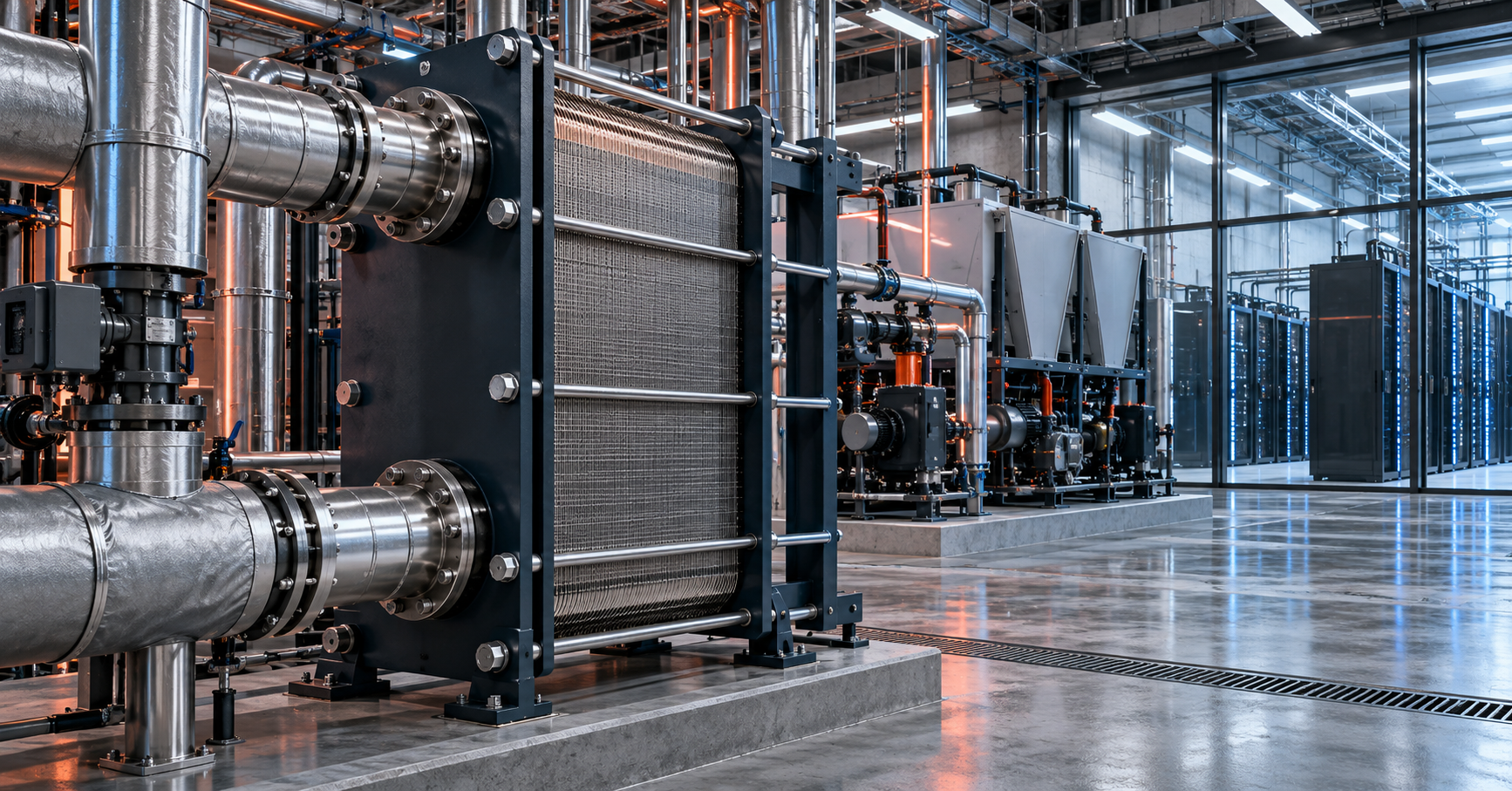
SLB’s 23 October results strengthen the commercial rationale for its proposed Kelvion acquisition. Data Center Solutions revenue increased 23% from the preceding quarter and 76% from a year earlier. SLB is already expanding the business into which it intends to integrate the heat-exchange manufacturer, giving the deal an established route to customers.
The economic attraction is a larger role in each data-center project: SLB could supply cooling technology alongside the infrastructure it already designs and assembles. At a $4.1 billion transaction value, the purchase needs to deliver profitable growth and the expected integration benefits. SLB’s net debt is broadly unchanged from a year earlier, although completing the acquisition alongside continued shareholder distributions will draw on cash generation and borrowing capacity.
From oilfield engineering to modular data-center infrastructure
SLB (NYSE: SLB) earns most of its revenue from technology, equipment and services used to find, develop and produce oil and gas. Its newer data-center business applies engineering, manufacturing and project-management capabilities to the physical facilities supporting computing, earning revenue from infrastructure and delivery services.
Its modular approach moves mechanical, electrical and plumbing work into controlled manufacturing environments. Equipment is assembled offsite and delivered for installation and commissioning while preparation continues at the customer’s site. For an operator building a large computing campus, parallel work can shorten the construction schedule and reduce the amount of coordination required onsite.
On the October earnings call, management reiterated an annualized data-center revenue run rate above $1 billion at the end of 2026 and above $2 billion at the end of 2027. These describe the pace of revenue at each year-end, not revenue earned across the entire year. Expansion into Asia and additional customer contracts give the manufacturing operation more opportunities to deploy its capacity.
The business remains a small part of SLB. Its wider All Other reporting category, which also contains oilfield asset-performance projects and carbon-capture activities, generated $544 million of third-quarter revenue against $9.45 billion for the group. AER calculates that the category represented 5.8% of group sales, with data centers accounting for only part of that amount. Energy operations therefore remain the main source of current earnings and cash, while data centers offer a growing diversification opportunity.
Growth also carries setup costs. Management’s quarterly remarks reported 8% sequential revenue growth in All Other but a decline in pretax operating income, attributing the decline to new data-center project ramp-up costs. The category does not disclose standalone data-center profitability. Its cost pressure nevertheless shows that new projects can require expenditure before contributing their full earnings benefit.
Cooling adds products to an existing delivery relationship
Kelvion makes heat exchangers and other equipment that transfers heat through, and ultimately out of, a facility. In a liquid-cooling system, for example, a heat exchanger transfers heat between separate fluid circuits without mixing them. The technical need grows as computing equipment concentrates more heat into a smaller space.
Its product range includes plate heat exchangers, heat-rejection equipment, generator cooling and other thermal systems. These serve data centers as well as energy and industrial customers. SLB would add the equipment and its associated engineering expertise to infrastructure projects where it already has a design or delivery role.
The commercial mechanism is straightforward: participation earlier in facility design can help secure the specification and eventual supply of cooling equipment. Owning the technology also allows SLB to coordinate its configuration with the modules it manufactures. Management expects the acquisition to more than double its potential revenue opportunity per gigawatt of delivered capacity. That measures the broader equipment scope available to sell, not a guaranteed doubling of sales on every contract.
The acquisition would bring 100% ownership of Kelvion, including the interests held by Apollo-managed and Triton-advised funds. The agreed consideration is approximately $3.4 billion cash to the sellers plus $700 million of assumed debt, producing the $4.1 billion total transaction value. The assumed debt is an obligation acquired with the business; it is separate from the cash paid for its equity.
The valuation includes more than a data-center business
Kelvion’s August acquisition announcement projected $2.3 billion–$2.4 billion of total 2026 revenue and $350 million–$400 million of adjusted EBITDA. Data-center revenue was expected to contribute $1.2 billion–$1.3 billion. The remaining business supplies applications including heat pumps, industrial processing, renewables and carbon capture.
| Management’s forecast scope | Revenue | Adjusted EBITDA |
|---|---|---|
| Kelvion, all businesses, 2026 | $2.3bn–$2.4bn | $350m–$400m |
| SLB and Kelvion data-center operations, pro forma 2026 | More than $2bn | Approximately $300m |
| Combined data-center ambition, 2028 | $4.5bn–$5bn | $700m–$800m |
The combined data-center ambition implies a much larger future earnings contribution: adjusted EBITDA would increase from approximately $300 million on a pro forma 2026 basis to $700 million–$800 million in 2028. Achieving that ambition depends on sustained growth across the combined infrastructure and cooling operations. The 2028 target represents the earnings of that broader combination, while the acquisition price buys Kelvion’s data-center and other industrial operations.
Kelvion brings an industrial earnings base as well as faster-growing cooling exposure. SLB quotes approximately 11 times estimated 2026 EBITDA before synergies, falling to roughly 8.5 times after the full annual synergy benefit. Both multiples apply to the entire acquired business.
The investor FAQ identifies $120 million of annual EBITDA synergies within three years, with about $70 million achieved in the second year. At full realization, approximately $70 million comes from cost savings and the remaining $50 million from additional sales opportunities. The latter is an earnings contribution from those opportunities, not a revenue target.
Procurement, logistics and administrative efficiencies provide identifiable cost mechanisms. The commercial component depends on customers buying the broader offering, including through expansion in Asia and the Middle East. Consequently, the lower quoted acquisition multiple incorporates both savings and business that must be won after closing. Management expects earnings-per-share and free-cash-flow-per-share accretion in the first 12 months, before the full synergy program is complete.
Cash generation must accommodate distributions and the purchase
SLB’s liquidity reconciliation reports $1.52 billion of free cash flow for the first nine months, against $1.83 billion a year earlier. Its definition deducts capital expenditure, investment in oilfield asset-performance projects and capitalized exploration data from operating cash flow. Higher working-capital absorption and investment spending contributed to the decline.
Dividends and share repurchases consumed $3.06 billion over the same period, exceeding free cash flow by approximately $1.54 billion. In the first nine months of 2025, those distributions totalled $3.59 billion against $1.83 billion of free cash flow, a gap of roughly $1.76 billion. The gap narrowed in 2026 as lower repurchases more than offset weaker free cash flow. These nine-month comparisons precede the stronger fourth-quarter cash generation management typically expects.
Net debt ended September at $9.25 billion, compared with $7.42 billion at December 2025 and $9.18 billion at September 2025. The year-on-year comparison shows a broadly stable debt position despite the increase since year-end. Cash and short-term investments were $3.55 billion at September, against $12.80 billion of gross debt. Kelvion’s cash purchase price will therefore be met from a combination of liquidity and new financing while SLB continues to fund its operations.
Management intends to fund Kelvion with existing cash and debt. Its financial framework retains a through-cycle net-debt-to-EBITDA target of no more than 1.5 times, meaning net debt of up to one and a half times annual EBITDA. Management expects to remain within that target after the acquisition. It also maintains more than $4 billion of shareholder distributions in 2026 and expects 2027 distributions at least in line with that level. The purchase adds both financing for the cash consideration and Kelvion’s assumed debt; the precise cash-versus-new-debt allocation remains undisclosed.
The quarterly prepared remarks maintained approximately $2.5 billion of full-year capital investment and anticipated stronger fourth-quarter cash flow from inventory reductions and customer collections. The timing of receipts in certain countries will influence that improvement. Faster collection would leave more internally generated cash available before Kelvion closes, while delayed receipts would increase dependence on borrowing or subsequent cash generation.
The benefit depends on project margins as well as equipment scope
The near-term operating outlook still rests heavily on energy activity. Management expects approximately $10 billion of fourth-quarter group revenue and a 1.0–1.5 percentage-point sequential improvement in adjusted EBITDA margin, assuming Middle East revenue remains broadly flat. Offshore projects, production equipment and year-end digital sales support that outlook. Data-center growth adds another source of demand but has not displaced the larger business’s role in generating cash.
Kelvion remains scheduled to close in the first half of 2027, subject to approvals and other conditions. It gives SLB a credible way to increase the equipment and engineering content supplied to existing data-center customers, and the latest growth strengthens that commercial case. Delivery of the $120 million annual synergy target and profitable expansion toward the combined 2028 earnings ambition would make the purchase a more meaningful contributor to SLB’s earnings. Nearer term, year-end cash conversion will influence how much borrowing is required at closing; successful project ramps would then improve the cash available to reduce that debt.
This material is provided for informational and educational purposes only and does not constitute investment advice or a recommendation to buy or sell any security.
Companies Discussed
About AER Insights
Alliance Equity Research publishes timely insights on company-specific developments, industry trends, capital markets activity, and emerging investment themes across global public markets, with a particular focus on undercovered companies, sectors, and developments that often receive limited attention from mainstream financial research. Our analysis focuses on the financial, strategic, and valuation implications behind the headlines, using company disclosures, filings, market data, and sector context to help investors understand what matters, why it matters, and what to watch next.
Get AER Insights by Email
Receive new AER Insights and research updates in your inbox.
Related Insights
 Mining & Critical Minerals
Serabi’s Coringa Permit Delay Defers the Returns From Its Expanded Processing Plant
Serabi Gold’s production cut shifts attention from building capacity to securing permission to use it. Cash provides a cushion, but delayed Coringa ore deliveries and weaker Palito grades reduce the near-term output available to recover development spending and support shareholder returns.
 Capital Markets & M&A
LSEG’s Octus Deal Expands Credit Data at a Price That Requires Sustained Growth
The $3.535 billion acquisition adds recurring revenue from credit research, private loan documents and portfolio tools. LSEG gains a credible route into specialist customer workflows, but debt funding and an initially neutral adjusted EPS impact leave sustained growth central to the return on its investment.
 Mining & Critical Minerals
Hudbay Approves Copper World as Partner Funding Cushions a Larger Capital Commitment
Copper World’s construction approval gives Hudbay a defined route to a new U.S. mine. Partner capital and planned borrowing defer its cash contributions, but the revised study increases the commitment and makes later expansion spending central to the expected production gains.
 Energy
 Transfer’s $2.6 Billion Vaquero Deal Buys Volumes for Its Wider Network
The acquisition adds contracted Delaware Basin gas-processing capacity already connected to Energy Transfer’s downstream infrastructure. Returns will depend on capturing additional transportation and export fees while funding a cash-heavy purchase alongside an expanding construction program.
About Alliance Equity Research
Alliance Equity Research publishes independent and company-sponsored equity research on undercovered, emerging, and high-potential public companies globally. Our analyst-built, model-backed research combines fundamental business analysis, financial forecasting, and valuation.
Email: info@alliancekp.com · Website: https://allianceequityresearch.com
For detailed company research, financial models, or coverage inquiries, contact our research team.
Research commentary for informational purposes. This document does not constitute personalized investment advice or a Buy, Hold, or Sell recommendation. For important disclosures, including information about research sponsorship and potential conflicts of interest, visit allianceequityresearch.com/disclosures.