Energy Transfer’s $2.6 Billion Vaquero Deal Buys Volumes for Its Wider Network
The acquisition adds contracted Delaware Basin gas-processing capacity already connected to Energy Transfer’s downstream infrastructure. Returns will depend on capturing additional transportation and export fees while funding a cash-heavy purchase alongside an expanding construction program.
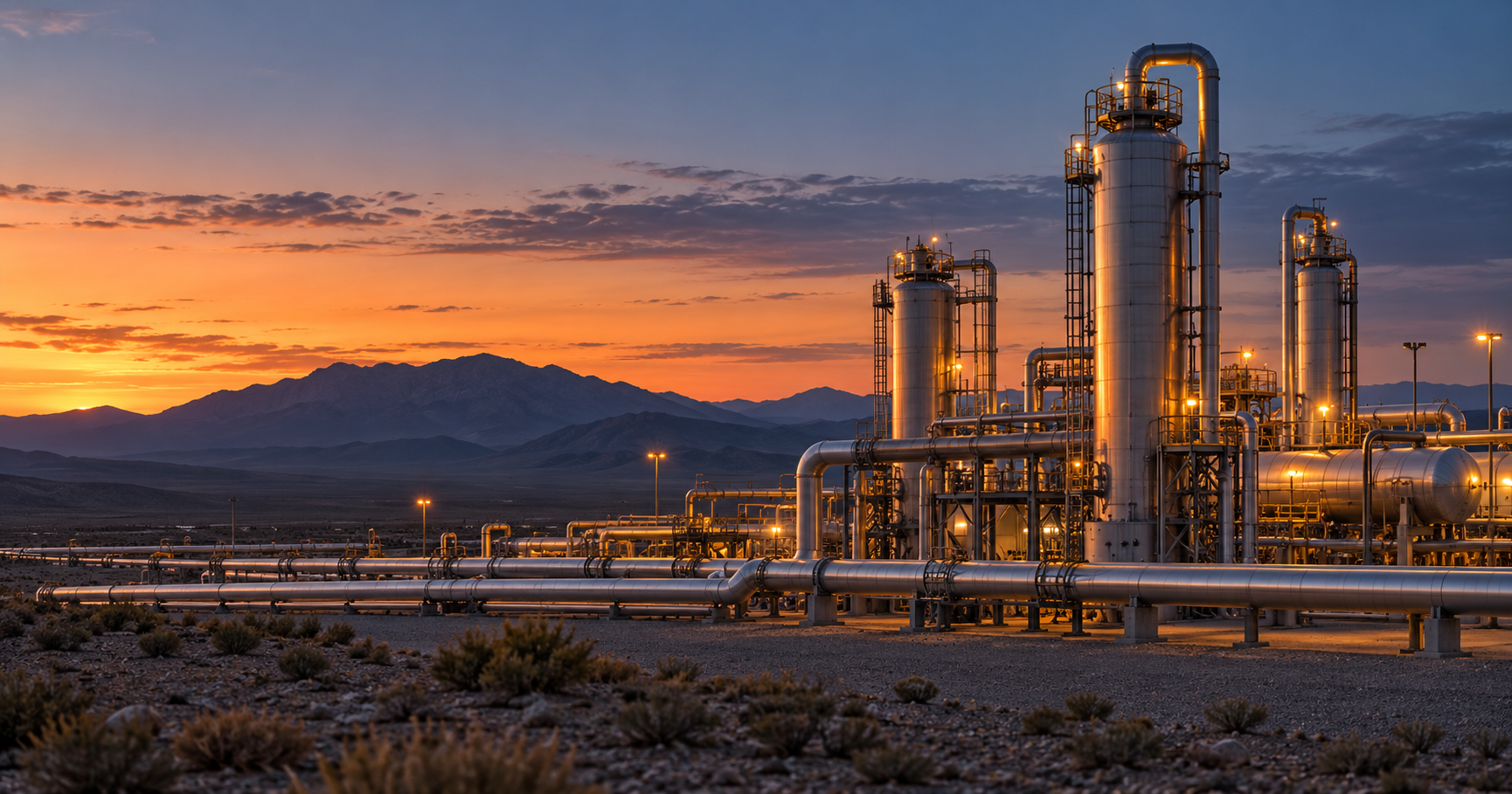
Buying an established connection to the network
Energy Transfer’s October 6 agreement to acquire Vaquero Midstream extends its reach into the Southern Delaware Basin. The $2.625 billion transaction combines $1.95 billion in cash with approximately 33.3 million newly issued common units. Closing is expected in the fourth quarter, subject to regulatory approval and customary conditions.
Vaquero’s assets already connect to Energy Transfer’s downstream natural gas and natural gas liquids infrastructure. That gives the acquisition a practical integration advantage: processing customers can supply volumes into an existing transportation, fractionation and export network. Management expects immediate accretion to distributable cash flow per common unit, although it has not quantified the expected uplift.
For unitholders, the investment case therefore extends beyond the acquired processing plants. Additional fees earned elsewhere in the system could improve the purchase economics, provided the volumes arrive, contracts support their routing and downstream capacity is available.
Contract coverage and room to expand
The acquired operating footprint includes approximately 300 miles of gathering and intrabasin pipelines and the Caymus Processing Complex. Its three processing trains provide 675 million cubic feet per day of capacity.
| Asset or commercial measure | Announced position |
|---|---|
| Existing processing capacity | 675 MMcf/d |
| Potential capacity with two additional trains | Approximately 1.2 Bcf/d |
| Dedicated acreage | Approximately 100,000 acres |
| Average remaining contract life | Approximately 10 years |
Long-term, fee-based firm contracts support the acquired business. Acreage dedication also gives Vaquero a position in future development across the contracted footprint, tying its growth opportunity to producers’ drilling schedules.
The potential expansion would add approximately 525 MMcf/d, increasing processing capacity by about 78%. That is an expansion opportunity requiring further investment; the announcement does not disclose the construction budget, timing or current plant utilization. Existing contract coverage provides a foundation, while producer activity and available takeaway capacity determine how quickly additional facilities could earn a return.
Permian gas growth supports the operating thesis
The broader basin has been producing more gas both as oil development expands and as producing wells become gassier. EIA data published in June show Permian marketed natural gas production rising from 17.2 Bcf/d in 2021 to 27.6 Bcf/d in 2025, an increase of approximately 60%. Oil production rose from 4.7 million to 6.6 million barrels per day over the same period.
That divergence creates demand for processing and transportation infrastructure even when oil growth moderates. The basin’s gas-to-oil ratio reached approximately 4,200 cubic feet per barrel in 2025, about 16% above its 2021 level. As reservoir pressure declines, a larger proportion of gas can emerge with the oil stream.
More recent EIA analysis published October 2 reported a 1.7 Bcf/d increase in Texas and New Mexico gross natural gas withdrawals between June and July 2026. EIA linked growth to new wells, increasing gas-to-oil ratios and expanded takeaway capacity. Gross withdrawals measure the wellstream before processing, so they are a different series from marketed production.
For Vaquero, basin growth supplies a favorable demand backdrop. Its commercial outcome will still depend on activity within its dedicated acreage: regional production growth can bypass an individual system if the strongest development occurs elsewhere.
Downstream capacity gives the purchase a second earnings channel
Energy Transfer has been expanding the infrastructure that can carry and monetize additional Permian volumes. Its second-quarter results reported completed Lone Star Express upgrades providing more than 90,000 barrels per day of incremental Permian NGL takeaway capacity. The partnership also signed long-term transportation and/or fractionation agreements covering approximately 300,000 barrels per day on its mixed-NGL assets.
At the Gulf Coast, the Nederland expansion announced in June will add 240,000 barrels per day of ethane export capacity and 55,000 barrels per day of LPG capacity. All of the additional ethane capacity is committed under long-term agreements extending into the 2040s.
These projects create several potential revenue points between processing and overseas delivery. Acquiring an upstream customer relationship can support utilization across that chain, improving the value of infrastructure already built or under construction.
The benefit depends on commercial capture. Some acquired volumes may already move through Energy Transfer’s network, and customer contracts may limit routing flexibility. Incremental downstream earnings will therefore depend on new volumes and additional services secured after acquisition.
Cash funding carries more weight than unit dilution
The purchase consideration is approximately 74% cash and 26% units, based on the announced total value. The cash requirement arrives alongside an elevated investment program: August guidance put 2026 growth capital spending at $5.6 billion to $5.9 billion.
| Funding measure | Amount or implication |
|---|---|
| Cash consideration | $1.95 billion |
| Implied unit consideration | $675 million |
| New common units | Approximately 33.3 million |
| New units as a share of illustrative post-issue total | Approximately 0.96% |
| Annual distributions on new units at the latest declared rate | Approximately $45.3 million |
The dilution estimate uses the 3.443 billion common units outstanding on July 31 and assumes no other changes. The distribution calculation applies the latest declared annualized rate of $1.36 per unit; future distributions remain subject to declaration.
The cash consideration equals approximately 34% of the midpoint of August’s growth-capital guidance. Acquisition spending and construction spending are separate categories, but both compete for financing capacity and retained cash.
Energy Transfer reported $2.59 billion of second-quarter distributable cash flow attributable to partners, as adjusted, and $3.764 billion available under its parent revolving credit facility at June 30. These provide funding context, although available revolver capacity is undrawn borrowing capacity. Adjusted distributable cash flow is a non-GAAP measure and does not represent cash remaining after growth investment and distributions.
Returns will become clearer with operating disclosure
The next useful disclosures are Vaquero’s current throughput, earnings contribution, contract economics and expansion requirements. Together, these would show how much of the purchase price is supported by existing cash generation and how much depends on future development.
A standalone EBITDA figure would also allow comparison with other midstream transactions. The announced purchase value alone cannot establish whether Energy Transfer secured an attractive acquisition multiple, particularly when part of the intended return comes from downstream assets outside Vaquero.
The strategic fit is credible: an established gathering and processing footprint feeds a network with transportation and export growth opportunities. Financial execution will determine the payoff. Evidence of rising utilization, additional downstream fees and accretion after financing costs would strengthen the case that the acquisition is improving returns across the wider system.
This material is provided for informational and educational purposes only and does not constitute investment advice or a recommendation to buy or sell any security.
About AER Insights
Alliance Equity Research publishes timely insights on company-specific developments, industry trends, capital markets activity, and emerging investment themes across global public markets, with a particular focus on undercovered companies, sectors, and developments that often receive limited attention from mainstream financial research. Our analysis focuses on the financial, strategic, and valuation implications behind the headlines, using company disclosures, filings, market data, and sector context to help investors understand what matters, why it matters, and what to watch next.
Get AER Insights by Email
Receive new AER Insights and research updates in your inbox.
Related Insights
 Technology & Semiconductors
Xanadu’s GlobalFoundries Partnership Moves Quantum Computing Toward Manufacturing, With Economics Still Unproven
A 300 mm foundry partnership addresses the production of photonic chips and detectors needed for Xanadu’s planned quantum systems. The investment case now depends on translating component performance into manufacturing yields, integrated demonstrators and commercially useful machines while controlling development spending.
 Biotechnology & Healthcare
Vaxcyte’s Phase 3 Success Advances a Broader Vaccine Toward Its Next Regulatory Tests
VAX-31 passed every primary endpoint in its pivotal adult trial, supporting a broader pneumococcal vaccine profile. Individual comparator results, remaining manufacturing studies and rising development spending will shape the path to Vaxcyte’s planned 2028 filing and eventual commercial opportunity.
 Capital Markets & M&A
Schneider’s $23.7 Billion PTC Deal Needs More Than Cost Savings
Schneider Electric is paying a 42.3% premium for PTC and funding most of the purchase with debt. The advertised valuation falls from 21 times to 13 times 2027 adjusted EBITA only after a demanding combination of cost savings and commercial synergies.
 Biotechnology & Healthcare
Jaypirca Moves Into First-Line CLL, Expanding Lilly’s Oncology Opportunity in a Crowded Market
FDA approval brings Lilly’s noncovalent BTK inhibitor into initial treatment for eligible patients with chronic lymphocytic leukemia. The commercial opportunity now extends earlier in the disease course, while competing targeted therapies, treatment duration and tolerability will determine how much of that opportunity becomes revenue.