 Alliance Equity Research
AI’s Memory Boom Is Lifting Chipmaker Profits and Raising Costs for Device Makers
The AI infrastructure buildout is changing the economics of the memory industry. Chipmakers are allocating capacity to high-value server products and securing longer-term customer commitments, while phone and computer manufacturers face higher component costs. IDC estimates that global smartphone shipments fell 22% in the third quarter, with memory shortages contributing to the downturn. The effects are uneven: earlier inventory purchases have helped some device makers, while others face margin pressure. New factories could eventually expand supply, but their timing, product mix and returns will shape the next stage of the cycle.

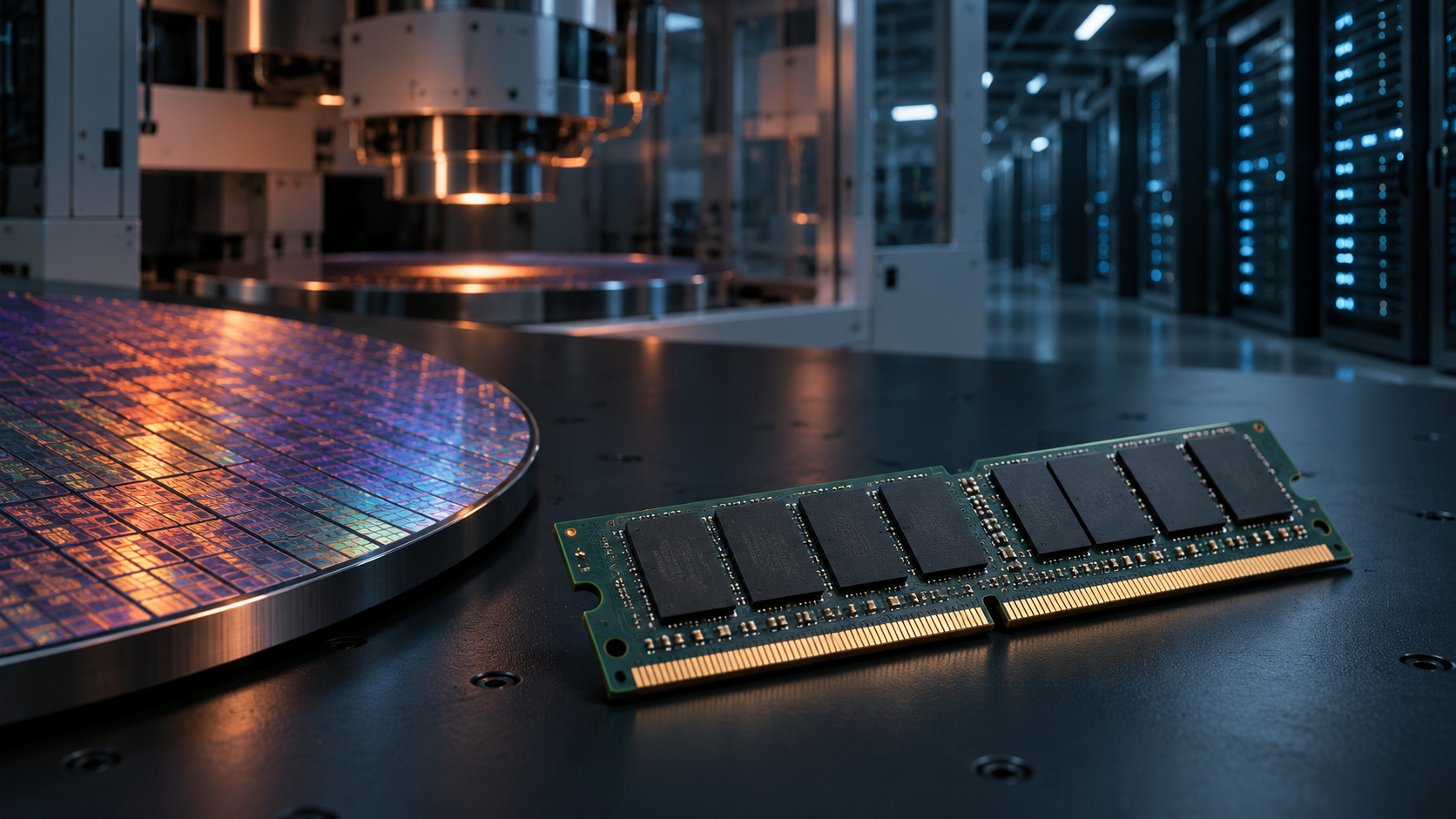
The AI infrastructure buildout is creating a divide across the technology industry. Memory suppliers are reporting sharply higher earnings and signing multiyear agreements to secure future demand. Companies that buy memory for phones, computers and other devices, meanwhile, face higher component costs and difficult decisions about pricing and product specifications.
The effects are now visible beyond the data center. According to preliminary IDC estimates, global smartphone shipments fell 22% year over year to 255.3 million units in the third quarter of 2026. IDC identified higher memory costs and constrained supply as major contributors to the downturn. The decline is an industry outcome, rather than a measure of the effect of memory costs alone.
For investors, the issue extends beyond whether AI spending continues to grow. The allocation of manufacturing capacity is influencing chip prices, customer contracts and device affordability. It is also encouraging a wave of factory investment whose returns will depend on market conditions when new supply becomes available.
Why AI demand affects ordinary devices
Memory is a broad category rather than a single interchangeable product. Dynamic random-access memory, or DRAM, temporarily holds data that a device is actively using. NAND flash provides longer-term storage in products such as smartphones, computers and solid-state drives.
AI systems use both. Servers need DRAM to handle data during computation and NAND-based storage to retain large datasets. A specialized form called high-bandwidth memory, or HBM, sits close to an AI processor and supplies data at high speed. HBM uses vertically stacked DRAM chips and advanced connections to move data through a wide interface.
The memory in an AI accelerator is not simply removed from a smartphone and placed in a server. The pressure comes from shared manufacturing resources and investment decisions. Producers must decide how much factory capacity, equipment and technical effort to allocate to different products. When more advanced capacity is directed toward server memory, less may be available for other DRAM products.
Packaging is another constraint. Stacking and connecting memory chips requires additional manufacturing steps, and the availability of front-end production, packaging and testing capacity can affect how quickly suppliers increase output. TrendForce expects server DRAM to remain undersupplied in the fourth quarter, citing constraints across these stages.
NAND has a separate production process and its own supply and demand dynamics. It is also affected by the growth of data-center storage. Higher demand for enterprise solid-state drives can influence how producers allocate NAND output across business and consumer applications.
Higher prices spread through the market
In its September 30 outlook, TrendForce projected that conventional DRAM contract prices would rise 10% to 15% sequentially in the fourth quarter of 2026. It expected overall NAND flash contract prices to increase 15% to 20% over the same period.
These were forecasts for broad contract-price categories, not reported increases for every product or customer. Pricing can differ by specification, contract duration and negotiation. TrendForce also noted that some server DRAM suppliers’ price increases could lag the wider market because of provisions in long-term agreements.
More recent product-specific commentary points to differences within the market. In late October, TrendForce described fourth-quarter smartphone mobile DRAM prices as flat to slightly higher, consolidating at elevated levels, while server DRAM contract prices had continued to rise during October. Those observations cover different products and measures from the earlier broad forecast.
| Market indicator | Latest observation |
|---|---|
| Conventional DRAM contract prices | Forecast to rise 10%–15% sequentially in Q4 2026 |
| NAND flash contract prices | Forecast to rise 15%–20% sequentially in Q4 2026 |
| Global smartphone shipments | 255.3 million units in Q3 2026, down 22% year over year |
| Raspberry Pi 5, 16GB | Price raised by $80 to $385 in November 2026 |
Sources: TrendForce, IDC and Raspberry Pi. TrendForce’s price changes are its September 30 forecasts; IDC shipment figures are preliminary.
A slower rate of price increases would not necessarily provide immediate relief to buyers. If memory prices rise by a smaller percentage in a later quarter, the cost per chip can still be higher than in the preceding period. The effect on a device maker’s reported margins also depends on inventory purchased earlier, supplier contracts, product mix and the prices it charges customers.
Suppliers gain visibility through longer contracts
The improvement in memory producers’ financial results has been substantial. Micron reported fiscal fourth-quarter revenue of $54.23 billion, compared with $11.32 billion a year earlier, and GAAP net income of $37.70 billion. These are company-wide results across its memory and storage businesses; they should not be attributed entirely to HBM or AI products.
Memory producers are also using the current demand environment to negotiate longer commitments from customers. For buyers, an agreement can provide greater confidence that supply will be available. For manufacturers, it can support decisions to invest in facilities that take years to build and bring into production.
SK hynix said it had signed long-term agreements with 14 major customers, with committed volume equivalent to more than half its total production capacity for 2027 and 2028. The company said the agreements include mechanisms that reflect market conditions within an agreed price range.
Micron has also emphasized longer-term customer commitments and deposits. As AER discussed in its earlier Insight on Micron’s expansion, those arrangements can improve demand visibility and provide financing support as the company builds additional capacity.
Micron says the deposits are expected to be returned toward the latter part of the agreements, assuming minimum purchase requirements are met. Their financing benefit therefore comes from making cash available during the intervening period.
Longer contracts also change how suppliers participate in the market. A price floor may support revenue if the market weakens, while a ceiling can limit the benefit if newly negotiated prices rise sharply. The value of an agreement depends on its pricing terms, committed volumes and production costs, as well as the duration of the commitment.
Device makers face a cost and volume trade-off
For companies that incorporate memory into finished products, higher costs create several choices. They can raise prices, accept lower margins, change product specifications or redesign their product mix. Each response has consequences for demand and competitiveness.
Apple expects gross margin of 45% to 46% in the December quarter, compared with a reported 47.9% in the September quarter. The September figure included an approximately one-percentage-point benefit from tariff refunds. Management identified higher memory costs and expenses associated with expanding Siri services as pressures on the December outlook.
Apple said earlier price increases and inventory purchased before recent cost increases provide some offset. Management nevertheless expects memory purchase prices to continue rising beyond the December quarter, while the benefit from existing inventory diminishes over time. That creates a lag between changes in component prices and their full effect on reported results.
A smaller manufacturer illustrates the pricing pressure more directly. On November 2, Raspberry Pi raised the price of its 16GB Raspberry Pi 5 by $80, from $305 to $385, an increase of approximately 26%. It also raised prices on certain 16GB Compute Module 5 products by $40.
The company cited a lack of alternative supply for 16GB DRAM as well as other component shortages. The increase did not apply across its entire product range, and Raspberry Pi held the price of its 16GB Raspberry Pi 500+ unchanged.
Raspberry Pi’s first-half results show how inventory and pricing decisions can temporarily improve a buyer’s economics during a shortage. Revenue increased 90% to $256.9 million, while gross profit per board rose from $8.00 to $12.20, helped by price increases and memory purchased at lower prices in 2025.
Its overall gross margin percentage nevertheless declined from 25% to 23% as higher selling prices increased the revenue base. The company said the benefit of its lower-cost opening inventory had largely been consumed, with current inventory costs moving closer to market prices.
Higher selling prices can protect some gross profit per unit, but they can also reduce the number of units sold. A company that holds prices steady may preserve demand or market share while accepting pressure on margins. Neither outcome can be assessed from revenue growth alone.
Smartphone volumes show the downstream pressure
IDC’s preliminary third-quarter smartphone data shows that the industry is experiencing the cost shock unevenly.
| Manufacturer | Q3 2026 shipments | Year-over-year change |
|---|---|---|
| Samsung | 57.8 million | (5.8%) |
| Apple | 57.3 million | (4.0%) |
| Xiaomi | 30.7 million | (29.2%) |
| OPPO | 25.6 million | (34.5%) |
| vivo | 19.1 million | (31.5%) |
| Total market | 255.3 million | (22.0%) |
Source: IDC Worldwide Quarterly Mobile Phone Tracker. Results are preliminary and represent branded shipments.
Apple and Samsung both shipped fewer phones, but their declines were considerably smaller than the industry’s. IDC attributed their relative resilience partly to stronger premium portfolios, while noting that brands more exposed to lower-priced devices faced difficult choices between margins and volume.
Memory costs alone did not necessarily cause each company’s decline. Regional exposure, product launches, competition and customer demand also affect shipments. The figures show why the same component inflation can have different commercial consequences: a lower-priced device has less room to absorb a higher bill of materials without a significant change in margin or retail price.
The pressure can also affect future inventory. IDC said some manufacturers had increased production plans ahead of expected supply constraints. If end demand remains weak, that response could leave the industry with excess finished products even while individual components remain difficult to secure.
New capacity will change the supply picture gradually
The current shortage gives memory producers a strong incentive to invest, but new supply arrives gradually. A fabrication plant must be constructed, equipped and qualified before it reaches useful output. Advanced memory can also require additional packaging and testing capacity.
Micron’s planned Singapore NAND facility illustrates the lead time. The company announced an approximately $24 billion investment over 10 years and said wafer output was scheduled to begin in the second half of calendar 2028. Initial output and full production are different milestones, so the announcement does not imply that the facility’s eventual capacity will be available immediately.
The type of capacity added also affects where supply constraints ease. A facility or production line designed for a particular memory technology may not relieve every shortage across the market. Investment directed toward AI-related products can expand supply for those customers without producing an equivalent increase in memory available for lower-cost devices.
Long-term agreements provide some visibility because a portion of future capacity is linked to identified customers. Producers nevertheless remain exposed to changes in customer requirements, pricing outside their contracts and the cost of bringing new factories online.
For investors, memory prices, device shipments and inventories will show how the current shortage is being absorbed across the supply chain. Over a longer period, the timing and utilization of new factories will determine whether today’s strong supplier earnings translate into attractive returns on the capital being committed. For device makers, inventory decisions and pricing power will influence how much of the higher component cost reaches their margins and customers.
This material is provided for informational and educational purposes only and does not constitute investment advice or a recommendation to buy or sell any security.
Companies Discussed
About AER Insights
Alliance Equity Research publishes timely insights on company-specific developments, industry trends, capital markets activity, and emerging investment themes across global public markets, with a particular focus on undercovered companies, sectors, and developments that often receive limited attention from mainstream financial research. Our analysis focuses on the financial, strategic, and valuation implications behind the headlines, using company disclosures, filings, market data, and sector context to help investors understand what matters, why it matters, and what to watch next.
Get AER Insights by Email
Receive new AER Insights and research updates in your inbox.
Related Insights
 Mining & Critical Minerals
Lifezone’s Kabanga Project Needs Near-Term Funding as Orion Investment Talks Advance
Lifezone Metals is negotiating a potential investment in its Kabanga nickel project while seeking additional capital for its near-term activities. The company says it needs funding by February 2027 to support its operations and maintain a loan covenant. Kabanga’s feasibility study envisages an underground mine and concentrator in Tanzania, with $942 million in estimated pre-production capital. The terms of the Tanzanian government agreement, project financing and any outside investment will determine how the project advances and how much of its future economics Lifezone retains.
 Biotechnology & Healthcare
PTC’s Sephience Launch Lifts Sales as Milestone Payments and Acquisitions Shape Cash Flow
PTC Therapeutics’ Sephience launch is driving rapid product revenue growth, with more than 2,000 patients receiving the phenylketonuria treatment worldwide at the end of September. The company has raised its annual product sales outlook and acquired an experimental gene therapy for Fabry disease. The financial picture is more complex than the revenue growth alone: Sephience’s success has triggered acquisition-related payments, and royalties reported from another medicine have already been sold. Continued patient access and the cost of expanding PTC’s portfolio will determine how much cash the business retains.
 Technology & Semiconductors
AXT’s Wafer Sales Surge as Subsidiary Financing Adds Capacity and Shares Future Earnings
AXT’s third-quarter sales more than doubled from a year earlier as demand for indium phosphide wafers used in optical communications accelerated. Higher volumes and a richer product mix helped lift gross margin to 56%. The company is expanding capacity through its Chinese subsidiary Tongmei, where a proposed outside investment would bring in capital but reduce AXT’s ownership. Export permits, the timing of customer deliveries and the terms attached to subsidiary funding will influence how much of the manufacturing growth ultimately benefits AXT shareholders.
 Technology & Semiconductors
Bel Fuse’s Data Business Drives Sales Growth and Higher Manufacturing Margins
Bel Fuse’s data-related products are lifting sales and factory margins, with growth extending beyond its identifiable AI customers. Fourth-quarter guidance supports continued demand, while a larger share count, Enercon’s minority-interest valuation and inventory investment shape how operating gains translate into shareholder earnings and cash.
About Alliance Equity Research
Alliance Equity Research publishes independent and company-sponsored equity research on undercovered, emerging, and high-potential public companies globally. Our analyst-built, model-backed research combines fundamental business analysis, financial forecasting, and valuation.
Email: info@alliancekp.com · Website: https://allianceequityresearch.com
For detailed company research, financial models, or coverage inquiries, contact our research team.
Research commentary for informational purposes. This document does not constitute personalized investment advice or a Buy, Hold, or Sell recommendation. For important disclosures, including information about research sponsorship and potential conflicts of interest, visit allianceequityresearch.com/disclosures.