 Alliance Equity Research
Advanced Energy’s Chip and Data-Center Growth Brings Higher Profits and Greater Cash Needs
Advanced Energy’s third-quarter sales rose 50% as demand increased for power equipment used in semiconductor manufacturing and data centers. Higher volumes and margins lifted operating profit, but the company also committed more cash to inventory and factory expansion. Its new Thailand facility has begun serving data-center customers, and management expects continued capital spending as it expands capacity. The results highlight both the earnings potential of supplying the technology buildout and the importance of converting rising shipments into cash as new products and production lines ramp.

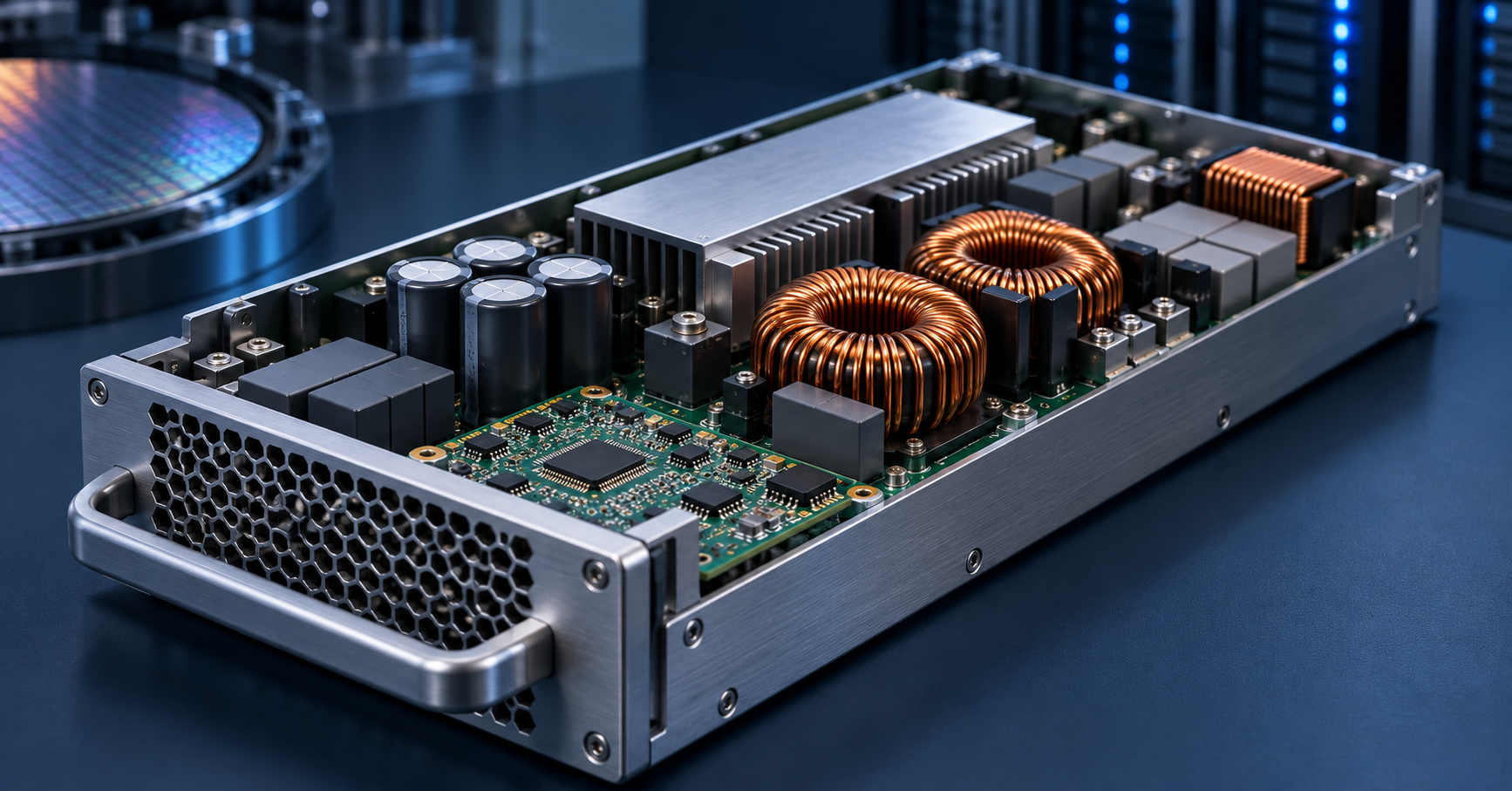
Advanced Energy Industries is benefiting from investment at two points in the technology supply chain: the equipment used to manufacture semiconductors and the infrastructure that powers data centers. Third-quarter revenue rose 50.3% from a year earlier to $696.4 million, with both markets contributing record sales.
The increase has lifted margins and operating profit. At the same time, Advanced Energy has committed more cash to components and factory capacity to meet customer demand. Its first nine months of 2026 illustrate that trade-off: revenue and earnings increased, while operating cash flow declined.
Supplying chip factories and data centers
Advanced Energy designs and manufactures power-conversion and control products. Its equipment adjusts electrical power to meet the requirements of customers’ machines, from semiconductor manufacturing tools to servers.
In semiconductor production, the company’s products help control processes such as etching and deposition, which remove and add material as chips are manufactured. These processes require power that can be delivered precisely and consistently.
For data centers, Advanced Energy supplies equipment that converts electricity into forms used by computing and networking systems. Customers must deliver more power within limited space, making the size and efficiency of power supplies increasingly relevant.
The products serve different customers, but demand for both can be influenced by investment in advanced computing. In its quarterly filing, Advanced Energy attributed semiconductor growth to stronger demand for equipment used in leading-edge manufacturing processes. It linked data-center growth to AI investment by large customers and earlier product design wins.
AER’s recent Insight on the memory industry examined another part of this investment cycle, including its effect on manufacturing capacity.
| Revenue by market | Q3 2025 | Q3 2026 | Year-over-year change |
|---|---|---|---|
| Semiconductor equipment | $196.6 million | $322.2 million | 63.9% |
| Data-center computing | $171.6 million | $256.2 million | 49.3% |
| Industrial and medical | $71.2 million | $90.5 million | 27.1% |
| Telecom and networking | $23.9 million | $27.5 million | 15.1% |
| Total | $463.3 million | $696.4 million | 50.3% |
Source: Advanced Energy third-quarter results. Growth rates are AER calculations.
Semiconductor equipment and data-center computing generated a combined $578.4 million, or 83.1% of quarterly revenue. They also accounted for $210.2 million of the company’s $233.1 million year-over-year revenue increase. The smaller industrial, medical, telecom and networking markets grew as well, but the performance of the two largest markets remains particularly influential.
Advanced Energy reports these as end-market revenue categories within a single operating segment. It does not disclose separate profit or margins for semiconductor equipment and data centers, so their individual contributions to the increase in earnings cannot be calculated from the available figures.
Sales growth is lifting margins
Higher sales have translated into a substantial improvement in profitability. According to the company’s third-quarter results, gross profit increased to $289.1 million from $174.4 million a year earlier. GAAP gross margin rose to 41.5% from 37.6%.
Operating expenses grew more slowly than gross profit. As a result, GAAP operating income increased to $143.2 million from $49.2 million, and operating margin rose to 20.6% from 10.6%.
Management attributed the improvement in adjusted gross margin to higher production volume and manufacturing efficiency. When sales grow faster than expenses, more revenue can flow through to operating income. The same relationship makes factory utilization important if customer demand weakens.
The company continues to invest in product development. Research and development expense was $67.1 million in the quarter, compared with $59.1 million a year earlier.
GAAP income from continuing operations rose to $115.8 million, or $2.80 per diluted share, from $46.4 million, or $1.21 per share, a year earlier. The sequential comparison is affected by a $31.8 million loss associated with an induced debt conversion that reduced second-quarter GAAP income.
Under the company’s non-GAAP methodology, third-quarter net income was approximately $150 million, compared with $112 million in the second quarter. The adjustments include stock-based compensation and other costs, so the adjusted figure should be considered alongside reported earnings.
More inventory supports growth and uses cash
Advanced Energy has increased its inventory as it prepares for customer demand. At September 30, inventories stood at $645.7 million, up from $411.2 million at December 31, 2025.
Other operating balances also grew. Accounts receivable increased from $325.2 million to $474.8 million, while accounts payable rose from $224.1 million to $363.2 million.
The balance-sheet changes do not translate individually into cash flow, but the cash-flow statement shows that changes in operating assets and liabilities used $249.3 million in the first nine months of 2026. Total operating cash flow was $144.1 million, down from $152.8 million a year earlier, even though total net income increased to $236.5 million from $96.1 million.
Noncash adjustments, including depreciation, stock-based compensation and the debt-conversion loss, also form part of the reconciliation between earnings and operating cash flow.
Management says its component inventory helps the company meet customer demand despite supply constraints. On the earnings call, it reported 144 days of inventory and said it expected inventory turns to remain around current levels over the next few quarters.
Holding more components can help Advanced Energy fill orders when parts are difficult to obtain. It also ties up cash and creates exposure if demand for particular components changes before they are used.
Factory expansion adds to cash requirements
Advanced Energy is investing in its manufacturing network as well as inventory. Purchases of property and equipment reached $117.2 million in the first nine months of 2026, compared with $69.9 million a year earlier.
Total operating cash flow less those purchases was $26.9 million for the period, before dividends and financing flows. Management expects full-year capital expenditure toward the low end of its $180 million to $195 million range and anticipates elevated spending in 2027. The annual range includes the $117.2 million already spent through September.
A major part of the expansion is a new facility in Thailand. In its November investor presentation, management said data-center customers had qualified the site during the third quarter, with semiconductor customers expected to follow.
The company is also expanding output at other facilities and is targeting capacity capable of supporting more than $5 billion in annual revenue by the end of 2028. For context, the midpoint of its fourth-quarter revenue guidance represents an annualized sales pace of $2.94 billion.
The $5 billion figure is a capacity objective, not a revenue forecast. Advanced Energy will need customer qualifications, sufficient component supply and continued orders to use the additional production capability.
New products could help fill that capacity. The company recently announced 3,200-watt and 3,600-watt power supplies for computing and networking applications and says it has won new semiconductor power designs. The eventual contribution from those products will depend on when customers incorporate them into production and how much they order.
Management also expects sales to a broader group of data-center customers to begin adding to hyperscaler revenue in 2027, although it described the initial contribution as relatively small.
The cash balance reflects financing as well as operations
Advanced Energy ended September with $1.425 billion in cash and equivalents, compared with $791.2 million at the end of 2025. Financing activity was a major contributor to the increase.
During the first nine months of 2026, the company received approximately $1.129 billion in net proceeds from new convertible notes due in 2031. It also paid $440.9 million to settle a portion of its 2028 notes and $69.0 million for capped calls, among other financing flows. In total, financing activities provided $610.2 million in cash.
At September 30, outstanding principal included $1.15 billion of 2031 notes and $136.4 million of 2028 notes. The company subsequently settled the remaining 2028 principal in cash and issued approximately 0.5 million shares for the excess conversion value.
The settlement reduced both cash and debt after the reporting date. The September cash balance therefore needs to be considered alongside the company’s borrowing obligations and subsequent payment.
What to watch next
Management expects fourth-quarter revenue of $710 million to $760 million. The $735 million midpoint is approximately 5.5% above third-quarter sales.
The company has also raised its expectation for full-year revenue growth to around 40%, from a previous low-to-mid-30% range. Its earlier third-quarter guidance called for revenue of $620 million to $660 million; actual sales exceeded the top of that range by $36.4 million.
For investors, the next quarterly results will show whether shipments continue to increase as the Thailand facility ramps and whether more of the company’s earnings convert into operating cash. Sustained margins, collections from customers and the pace of inventory investment will influence how much cash Advanced Energy can generate to fund its expansion.
This material is provided for informational and educational purposes only and does not constitute investment advice or a recommendation to buy or sell any security.
Companies Discussed
About AER Insights
Alliance Equity Research publishes timely insights on company-specific developments, industry trends, capital markets activity, and emerging investment themes across global public markets, with a particular focus on undercovered companies, sectors, and developments that often receive limited attention from mainstream financial research. Our analysis focuses on the financial, strategic, and valuation implications behind the headlines, using company disclosures, filings, market data, and sector context to help investors understand what matters, why it matters, and what to watch next.
Get AER Insights by Email
Receive new AER Insights and research updates in your inbox.
Related Insights
 Technology & Semiconductors
AI’s Memory Boom Is Lifting Chipmaker Profits and Raising Costs for Device Makers
The AI infrastructure buildout is changing the economics of the memory industry. Chipmakers are allocating capacity to high-value server products and securing longer-term customer commitments, while phone and computer manufacturers face higher component costs. IDC estimates that global smartphone shipments fell 22% in the third quarter, with memory shortages contributing to the downturn. The effects are uneven: earlier inventory purchases have helped some device makers, while others face margin pressure. New factories could eventually expand supply, but their timing, product mix and returns will shape the next stage of the cycle.
 Mining & Critical Minerals
Lifezone’s Kabanga Project Needs Near-Term Funding as Orion Investment Talks Advance
Lifezone Metals is negotiating a potential investment in its Kabanga nickel project while seeking additional capital for its near-term activities. The company says it needs funding by February 2027 to support its operations and maintain a loan covenant. Kabanga’s feasibility study envisages an underground mine and concentrator in Tanzania, with $942 million in estimated pre-production capital. The terms of the Tanzanian government agreement, project financing and any outside investment will determine how the project advances and how much of its future economics Lifezone retains.
 Biotechnology & Healthcare
PTC’s Sephience Launch Lifts Sales as Milestone Payments and Acquisitions Shape Cash Flow
PTC Therapeutics’ Sephience launch is driving rapid product revenue growth, with more than 2,000 patients receiving the phenylketonuria treatment worldwide at the end of September. The company has raised its annual product sales outlook and acquired an experimental gene therapy for Fabry disease. The financial picture is more complex than the revenue growth alone: Sephience’s success has triggered acquisition-related payments, and royalties reported from another medicine have already been sold. Continued patient access and the cost of expanding PTC’s portfolio will determine how much cash the business retains.
 Technology & Semiconductors
AXT’s Wafer Sales Surge as Subsidiary Financing Adds Capacity and Shares Future Earnings
AXT’s third-quarter sales more than doubled from a year earlier as demand for indium phosphide wafers used in optical communications accelerated. Higher volumes and a richer product mix helped lift gross margin to 56%. The company is expanding capacity through its Chinese subsidiary Tongmei, where a proposed outside investment would bring in capital but reduce AXT’s ownership. Export permits, the timing of customer deliveries and the terms attached to subsidiary funding will influence how much of the manufacturing growth ultimately benefits AXT shareholders.
About Alliance Equity Research
Alliance Equity Research publishes independent and company-sponsored equity research on undercovered, emerging, and high-potential public companies globally. Our analyst-built, model-backed research combines fundamental business analysis, financial forecasting, and valuation.
Email: info@alliancekp.com · Website: https://allianceequityresearch.com
For detailed company research, financial models, or coverage inquiries, contact our research team.
Research commentary for informational purposes. This document does not constitute personalized investment advice or a Buy, Hold, or Sell recommendation. For important disclosures, including information about research sponsorship and potential conflicts of interest, visit allianceequityresearch.com/disclosures.