 Alliance Equity Research
Data I/O’s V-TEK Acquisition Broadens Its Offering but Adds Cash and Dilution Costs
Data I/O’s $23 million acquisition combines chip programming, handling equipment and outsourced services. The commercial fit is credible, but the cash commitment and convertible financing increase the earnings and cash contribution needed to reward shareholders. Disclosed acquired financial information remains insufficient to assess the purchase return.
A broader role in preparing chips for production
Data I/O completed its acquisition of V-TEK and A&J Programming on October 21. The purchase broadens its role in preparing chips for electronics manufacturing, combining programming technology with handling equipment and outsourced services. That industrial fit is credible, but the $20 million cash payment and additional equity claims commit financial resources before the acquired earnings contribution is sufficiently disclosed to assess the return.
Data I/O supplies systems that load software and data into semiconductor devices before those devices enter an electronics assembly line. Its security provisioning technology can also install cryptographic keys and device identities, helping manufacturers establish which software and devices can be trusted. For example, an automotive supplier needs the appropriate firmware securely installed in a controller before incorporating it into a vehicle component.
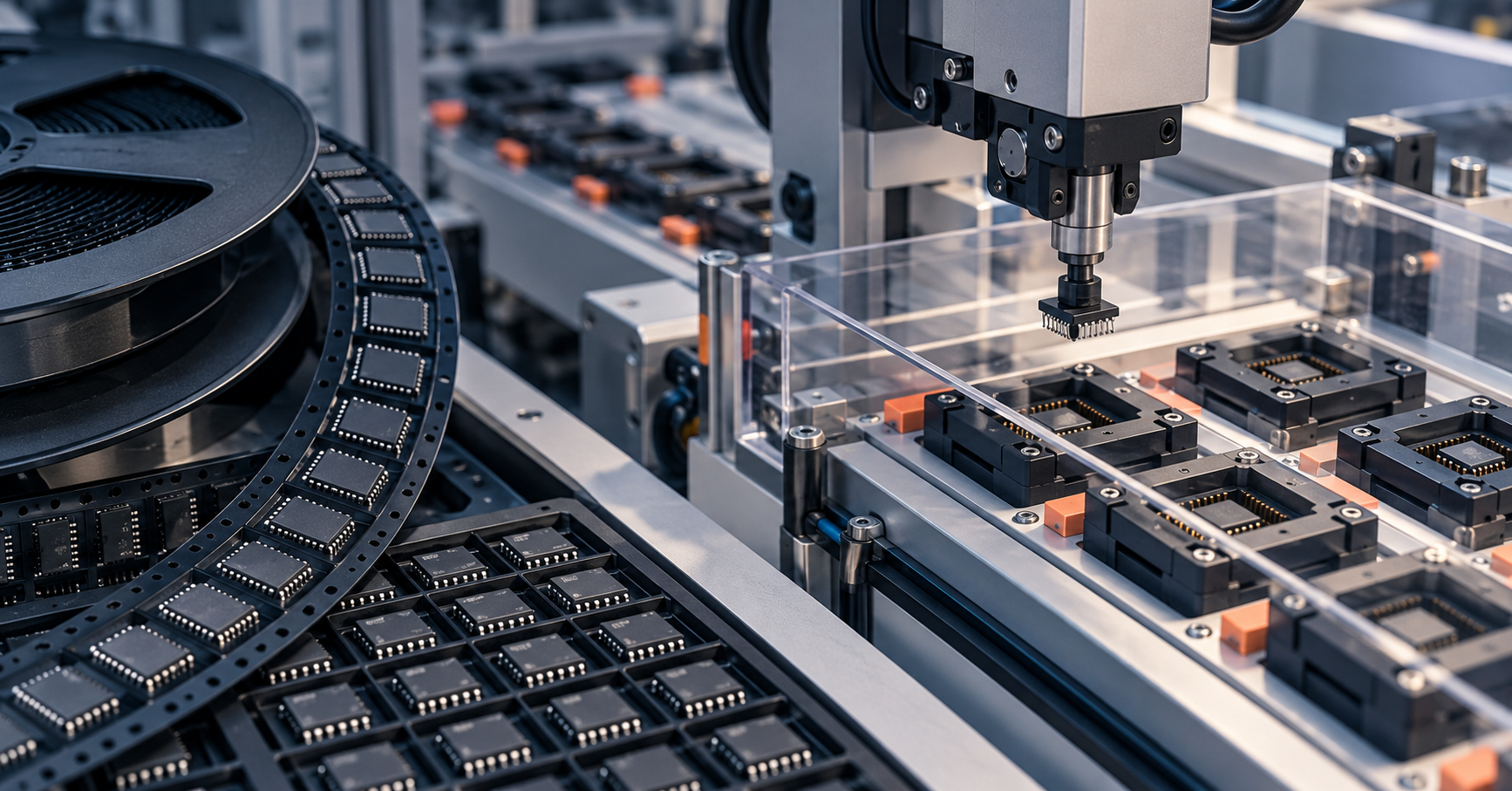
V-TEK adds physical handling, inspection, testing and packaging systems; A&J adds a programming service operation. These are adjacent production activities: a device needs the correct software, checks and physical presentation for the next manufacturing step. Offering more of that workflow could deepen customer relationships and expand distribution opportunities. Management expects the combination to roughly double revenue, but has not published acquired financial statements in the closing materials.
A wider production offering, with potential service benefits
Customers can buy equipment and program chips internally or send devices to a specialist service provider. A&J gives Data I/O more capacity to serve the second group. The combination therefore expands how the business can fulfil orders, alongside the equipment sales that have historically exposed Data I/O to customers’ capital-spending cycles.
Under Data I/O’s on-site Programming-as-a-Service offering, customers pay for each device programmed. Data I/O owns, maintains and updates the deployed equipment. The customer avoids buying the machine upfront, while Data I/O earns revenue as production passes through it.
For an on-site deployment, Data I/O must recover equipment, maintenance and support costs from the volume processed. The arrangement can extend revenue beyond an initial machine sale, while leaving utilisation and equipment funding risk with Data I/O. A&J’s service expertise may support expansion, but the acquired service revenue mix, contract economics and required investment have not been quantified.
Management identifies cross-selling, shared operating costs and lower-cost domestic manufacturing as potential benefits. Selling related products through combined channels could increase revenue per customer; using acquired tooling and manufacturing capabilities could improve margins. These are plausible mechanisms, although the release provides no quantified savings, implementation costs or timetable. A less cyclical revenue mix remains a management objective, not an established result of closing.
The cash purchase draws on new financing and existing liquidity
The approximately $23 million purchase consideration comprised $20 million in cash and $3 million in common stock. The October 19 signing announcement identified cash on hand and the securities offering as cash funding sources; the closing release confirms that the placement supplied part of the cash payment.
| Cash funding and purchase consideration | US$ million |
|---|---|
| Cash paid to sellers | 20.00 |
| Announced placement gross proceeds | 13.25 |
| Cash requirement beyond gross placement proceeds | 6.75 |
| Separate stock consideration to sellers | 3.00 |
| Total cash and stock purchase consideration | 23.00 |
The signing announcement estimated approximately 1.12 million common shares for the sellers. Those shares satisfy the $3 million stock component; they do not supply cash for the $20 million payment. Even applying the entire gross placement amount to the purchase would leave $6.75 million to be funded from existing resources, with fees increasing the requirement. The releases do not provide a complete closing cash reconciliation.
Data I/O reported $10.843 million of cash at June 30, already including $8.3 million of net proceeds from its June financing. The $6.75 million purchase-funding difference is material against that balance. Operating cash movements between June and October and transaction expenses prevent a reliable post-closing cash estimate, but the direction is clear: the acquisition uses part of the liquidity previously raised to support the growth strategy.
Convertible financing creates a further equity claim
The October financing announcement describes a $13.25 million offering of common shares and convertible subordinated debentures. Its stated conversion allocations identify $11.25 million of debenture principal; the remaining $2 million is the arithmetic residual attributable to the common-share component, not a separately stated allocation.
| Debenture principal | Conversion route |
|---|---|
| $7.25 million | Common stock at $2.68 per share |
| $4.00 million | Non-voting preferred at $1,000 per preferred share; subsequently convertible into common at $2.68 per share |
The $11.25 million principal represents approximately 4.20 million common-share equivalents at $2.68 per share. That calculation excludes directly issued common shares, any interest-related issuance and earlier securities.
The debentures carry a five-year term and interest of 5% in year one, increasing one percentage point annually until conversion. The release provides for automatic conversion and a shareholder meeting expected within 120 days of closing to approve common issuance above 19.9% of outstanding shares, but does not spell out the full conversion triggers. Receipt of the cash should therefore not be equated with immediate conversion of every security.
The earlier June financing also introduced convertible securities and warrants. The August results subsequently reported conversion of that debenture into preferred equity, eliminating the associated debt. Its potential common-share claim still belongs in the capitalisation analysis. Adding the acquisition shares and October securities enlarges the ownership claims against future earnings; a dependable dilution percentage requires all those instruments and their conversion conditions to be reconciled.
Higher margins preserved gross profit, but operating losses continued
The second-quarter financial statements show revenue of $5.149 million against $5.948 million a year earlier. Gross margin improved to 57.0% from 49.8%, leaving reported gross profit almost unchanged at $2.935 million versus $2.960 million. Better margin protected gross profit despite lower sales; it did not generate additional gross profit in dollars.
Operating expenses fell to $3.659 million from $3.804 million, narrowing the operating loss to $724,000 from $844,000. This provides a more precise picture of the standalone recovery: improved margin and lower expenses reduced the loss, while the business remained unprofitable. Acquired revenue will improve that position only to the extent that its gross profit exceeds the operating costs needed to deliver it.
Management expects the acquisition to be accretive, meaning it should improve earnings, but has not supplied a quantified bridge from acquired revenue to combined earnings. The closing release also lacks acquired profit figures sufficient to assess the purchase multiple. Cross-selling and manufacturing savings could improve the return, while integration spending, service capacity and financing costs could absorb part of the benefit.
The industrial benefit is clearer than the financial return
Data I/O now offers more of the programming and handling workflow, with additional service capability and potential access to a broader customer base. That strengthens the commercial proposition. The financial trade-off is immediate: cash has been committed and additional ownership claims created while the standalone business is still reporting an operating loss.
The available disclosures support a broader business, but do not yet establish that the acquired profits justify the purchase price and financing. The combined group needs incremental gross profit from acquired operations, cross-selling and cost efficiencies to exceed retained operating costs, integration expenditure and financing costs. Growth that absorbs cash or depends on underused service equipment would deliver a weaker shareholder return.
Sustained combined operating profit and cash generation after equipment investment would strengthen the assessment, particularly if reported alongside a reconciled common-share and convertible-security base. Continued losses or greater cash absorption would make the acquisition’s capital commitment more burdensome. The relevant improvement is profitable growth per ownership claim, beyond the increase in consolidated revenue.
This material is provided for informational and educational purposes only and does not constitute investment advice or a recommendation to buy or sell any security.
Companies Discussed
About AER Insights
Alliance Equity Research publishes timely insights on company-specific developments, industry trends, capital markets activity, and emerging investment themes across global public markets, with a particular focus on undercovered companies, sectors, and developments that often receive limited attention from mainstream financial research. Our analysis focuses on the financial, strategic, and valuation implications behind the headlines, using company disclosures, filings, market data, and sector context to help investors understand what matters, why it matters, and what to watch next.
Get AER Insights by Email
Receive new AER Insights and research updates in your inbox.
Related Insights
 Biotechnology & Healthcare
Roivant’s Uveitis Results Give Brepocitinib a Stronger Route to a Second Market
Two positive Phase 3 studies strengthen the case for expanding brepocitinib beyond its newly approved use in dermatomyositis. Durable disease control after steroid withdrawal supports a commercial opportunity in eye inflammation, although the higher studied dose, safety profile and established alternatives will influence its reach.
 Mining & Critical Minerals
Cornish Metals’ £135 Million Raise Would Unlock South Crofty Funding at a Dilutive Price
Cornish Metals has proposed the equity financing needed to advance South Crofty and release its escrowed bond funding. The package also converts shareholder loans and introduces Glencore as a buyer of future production. Existing shareholders gain a clearer construction path while sharing the eventual returns across substantially more shares.
 Technology & Semiconductors
ASML’s Capacity Shortfall Is Increasing the Value of Machines Already in Service
ASML’s latest results show chipmakers spending more to increase output from existing equipment as demand outpaces planned manufacturing capacity. Productivity upgrades are supporting margins, while the next expansion phase will test how quickly ASML and its suppliers can deliver additional systems.
 Technology & Semiconductors
Wolfspeed’s $1.5 Billion Government Loan Comes With a $750 Million Capital Test
The conditional 30-year facility could replace high-cost first-lien debt and fund U.S. silicon carbide and gallium nitride capacity. Yet no loan has closed, later draws require commercial milestones, and Wolfspeed must provide at least $750 million of qualifying capital while issuing warrants.
About Alliance Equity Research
Alliance Equity Research publishes independent and company-sponsored equity research on undercovered, emerging, and high-potential public companies globally. Our analyst-built, model-backed research combines fundamental business analysis, financial forecasting, and valuation.
Email: info@alliancekp.com · Website: https://allianceequityresearch.com
For detailed company research, financial models, or coverage inquiries, contact our research team.
Research commentary for informational purposes. This document does not constitute personalized investment advice or a Buy, Hold, or Sell recommendation. For important disclosures, including information about research sponsorship and potential conflicts of interest, visit allianceequityresearch.com/disclosures.