ASML’s Capacity Shortfall Is Increasing the Value of Machines Already in Service
ASML’s latest results show chipmakers spending more to increase output from existing equipment as demand outpaces planned manufacturing capacity. Productivity upgrades are supporting margins, while the next expansion phase will test how quickly ASML and its suppliers can deliver additional systems.
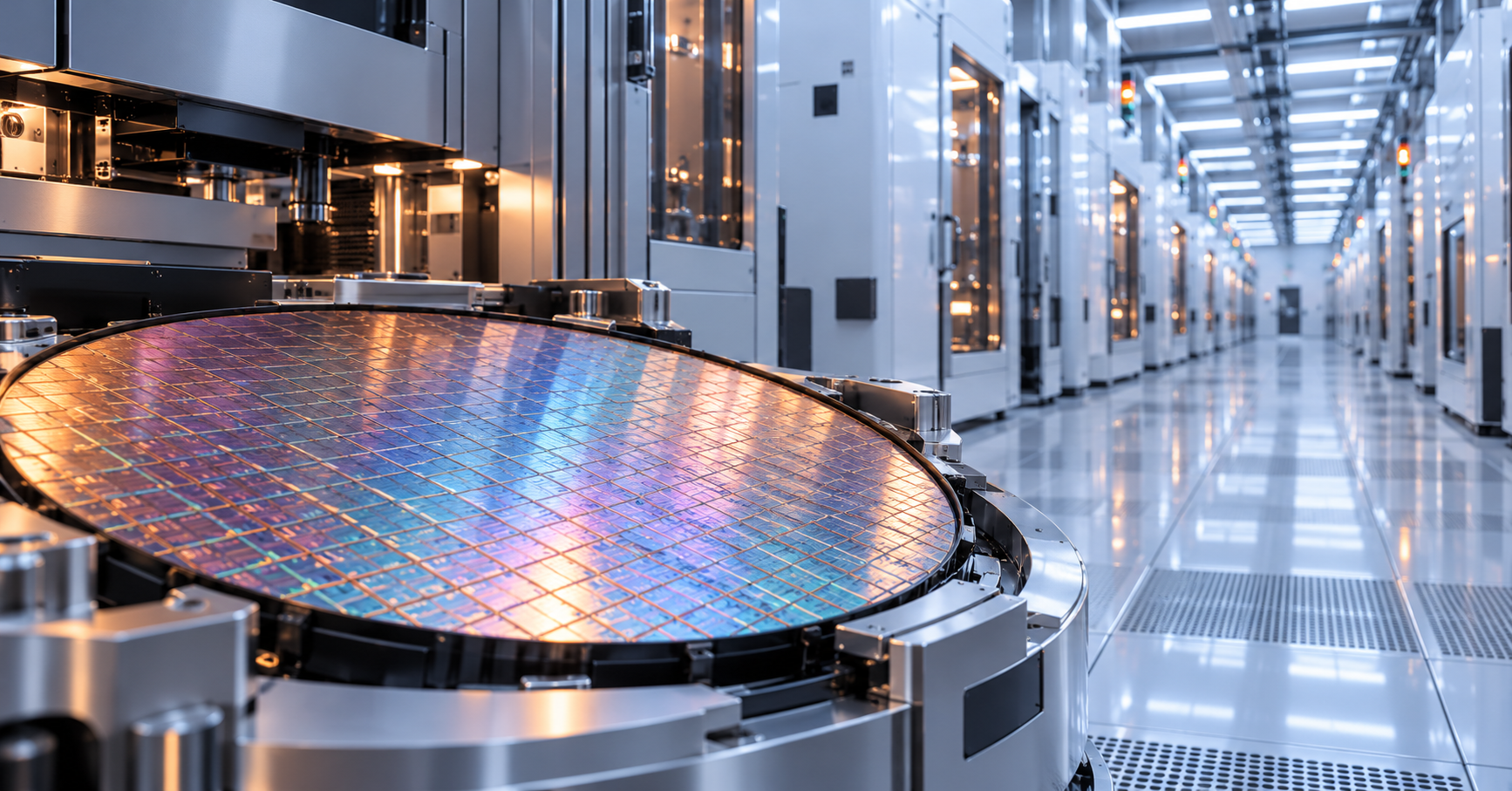
ASML reported €11.7 billion of quarterly revenue on October 14, alongside a warning that its currently planned supply for 2027 and 2028 would fall short of customer demand. For the Dutch semiconductor-equipment manufacturer, that combination creates two opportunities: delivering more machines and helping customers produce more chips with the equipment they already own.
The third-quarter announcement shows both contributing. Revenue from servicing and upgrading installed equipment reached €3.3 billion, helping lift gross margin to 57.5%. Management is now examining additional manufacturing capacity beyond its previously discussed expansion plans.
How ASML earns money from a chip factory
ASML supplies the lithography equipment that chipmakers use to print circuit patterns onto silicon wafers. Its technology combines precision optics, mechanics and software to reproduce those patterns repeatedly across a wafer and through successive manufacturing layers. Different layers require different levels of precision, so a factory uses several types of lithography equipment.
Extreme ultraviolet, or EUV, systems handle particularly small features; deep ultraviolet, or DUV, systems serve other layers and manufacturing requirements. ASML also sells services and upgrades for machines operating at customer sites. This gives the business an ongoing relationship with equipment after its initial installation.
For a chipmaker, the economics depend partly on how many usable wafers a machine can process within a given period. An upgrade that raises throughput can increase output within an existing factory footprint. Our interpretation is that this becomes especially attractive when new equipment takes time to obtain: customers can pursue additional production while their larger expansion projects progress.
Upgrades are contributing to the margin improvement
In the results interview, management said installed-base revenue exceeded its quarterly forecast by approximately €400 million, primarily because of upgrade demand. It also identified that business as a principal contributor to the gross-margin outperformance.
The product roadmap illustrates the mechanism. ASML expects its NXE:3800F system, initially available in small quantities in 2027, to increase throughput from 230 to 260 wafers per hour. That represents approximately 13% more nominal throughput. Actual factory benefits will also depend on utilization, process requirements and constraints elsewhere in production.
This offers a useful way to assess the business. Equipment shipments measure one source of growth, while productivity improvements create another route to customer value. The commercial opportunity depends on the value of additional wafer output relative to the cost and implementation requirements of an upgrade.
Pricing provides a further potential contribution. Management said discussions on value-based pricing had concluded with key customers, with effects beginning partly in 2027 and becoming fully visible from 2028. Consequently, the timing of pricing benefits extends beyond the current quarter’s improvement.
Expanding supply requires more than additional factory space
ASML’s July capacity plan started from approximately 65 conventional EUV systems and 130 DUV immersion systems of annual capacity in 2026. It envisaged a 30% increase in 2027 and was investigating another 30% increase in 2028. Two successive increases of that size would compound to approximately 69% above the starting capacity.
These plans concern specific equipment categories. They provide a framework for manufacturing expansion, with actual shipments dependent on execution and customer requirements. October’s warning indicates that customer demand forecasts have continued to rise against that framework.
The timing of ASML’s new Eindhoven campus helps explain why the response takes time. Construction began in September, with the first phase expected to finish in 2029. That phase will accommodate at least 3,000 employees, primarily teams relocating from existing locations.
A planned flow-factory model is intended to improve how modules, materials and installation work move through production. Our assessment is that manufacturing processes and supplier readiness deserve as much attention as the physical building: additional floor space becomes useful capacity only when the necessary components, people and production sequences are available. The 2029 completion date also places this investment beyond the immediate 2027–2028 supply challenge.
Reported profit includes an investment gain
ASML’s US GAAP financial statements reconcile third-quarter earnings as follows:
| Q3 2026 earnings bridge | € million |
|---|---|
| Gross profit | 6,699.8 |
| Research and development | (1,174.4) |
| Selling, general and administrative costs | (352.6) |
| Operating income | 5,172.8 |
| Gain on equity investments | 509.7 |
| Interest and other, net | 68.2 |
| Income taxes | (925.0) |
| Equity-method investment profit | 134.7 |
| Net income | 4,960.4 |
Management attributed approximately €500 million to revaluing its initial Mistral AI investment. Operating income therefore provides a cleaner starting point for examining equipment-business performance.
Operating cash flow was €11,797.6 million, including a €7,009.0 million contribution from changes in assets and liabilities. Deducting €413.3 million of property and equipment purchases and €33.9 million of intangible purchases gives calculated free cash flow of €11,350.4 million.
After all investing and financing flows and currency effects, cash increased €1,359.0 million to €8,030.9 million. Short-term investments added €4,704.2 million, taking combined liquidity to €12,735.1 million. The working-capital contribution makes quarterly cash conversion sensitive to payment timing.
A larger fourth quarter creates the next execution test
ASML expects fourth-quarter revenue of €14.2 billion–€15.2 billion, with gross margin around 57%. Full-year revenue guidance is now €44 billion–€45 billion, compared with July’s €43 billion–€45 billion range. The change raises the lower bound while retaining the previous upper bound.
For the investment case, the next evidence will come from three connected outcomes: delivery of the larger quarterly revenue target, sustained customer spending on upgrades, and a more concrete plan for additional manufacturing output. These will help establish how much of today’s demand visibility can become profitable sales within the next two years.
Longer-term customer forecasts still involve uncertainty. ASML identifies order delays, cancellations, export restrictions and component availability among its risks. Capacity investment therefore requires decisions before all future revenue is secured.
The issue to follow is whether additional machines, higher throughput and pricing can advance together. A delay in any one of those areas would change the timing of earnings growth even if customers’ underlying appetite for more wafer capacity remains intact.
This material is provided for informational and educational purposes only and does not constitute investment advice or a recommendation to buy or sell any security.
About AER Insights
Alliance Equity Research publishes timely insights on company-specific developments, industry trends, capital markets activity, and emerging investment themes across global public markets, with a particular focus on undercovered companies, sectors, and developments that often receive limited attention from mainstream financial research. Our analysis focuses on the financial, strategic, and valuation implications behind the headlines, using company disclosures, filings, market data, and sector context to help investors understand what matters, why it matters, and what to watch next.
Get AER Insights by Email
Receive new AER Insights and research updates in your inbox.
Related Insights
 Biotechnology & Healthcare
Two Phase 3 Wins Give Bristol Myers New Options Beyond Its Current Portfolio
Bristol Myers Squibb has reported successful pivotal trials in pulmonary fibrosis and radiopharmaceutical oncology. The readouts strengthen two future-growth programs, including the lead asset from its $4.1 billion RayzeBio acquisition, although the data disclosed so far are insufficient to estimate their commercial value.
 Industrials & Aerospace
Volution’s Acquisition Strategy Is Broadening Its Markets and Increasing Its Funding Needs
Volution’s latest results show how a ventilation manufacturer can grow through acquisitions while improving operating margins. Expansion into mining and European heat recovery adds new customers, but acquisition payments are absorbing cash and increasing the importance of returns on invested capital.
 Technology & Semiconductors
Wolfspeed’s $1.5 Billion Government Loan Comes With a $750 Million Capital Test
The conditional 30-year facility could replace high-cost first-lien debt and fund U.S. silicon carbide and gallium nitride capacity. Yet no loan has closed, later draws require commercial milestones, and Wolfspeed must provide at least $750 million of qualifying capital while issuing warrants.
 Technology & Semiconductors
Xanadu’s GlobalFoundries Partnership Moves Quantum Computing Toward Manufacturing, With Economics Still Unproven
A 300 mm foundry partnership addresses the production of photonic chips and detectors needed for Xanadu’s planned quantum systems. The investment case now depends on translating component performance into manufacturing yields, integrated demonstrators and commercially useful machines while controlling development spending.