 Alliance Equity Research
Constellium’s Recycling Gains Lift Earnings, but Higher Metal Prices Tie Up More Cash
Constellium’s higher earnings outlook reflects stronger recycling benefits and product economics despite slightly lower shipments. More expensive metal also increases working-capital requirements. Packaging and automotive sheet now drive most of the earnings improvement, making scrap costs, manufacturing efficiency and new capacity central to sustaining returns.


Constellium raised its 2026 earnings outlook on 28 October after stronger recycling economics and product mix lifted profits despite slightly lower shipments. The aluminum manufacturer now expects adjusted EBITDA excluding metal-price lag of $1.03 billion–$1.06 billion, compared with $980 million–$1.02 billion previously. Its free-cash-flow forecast remains above $300 million.
The third-quarter results show a business earning more from the material it processes. Packaging and automotive sheet generated almost all the increase in earnings before metal-price timing effects. That improvement supports investment, debt reduction and buybacks, although higher metal prices also increase the cash required to carry inventory.
How processing and metal sourcing generate earnings
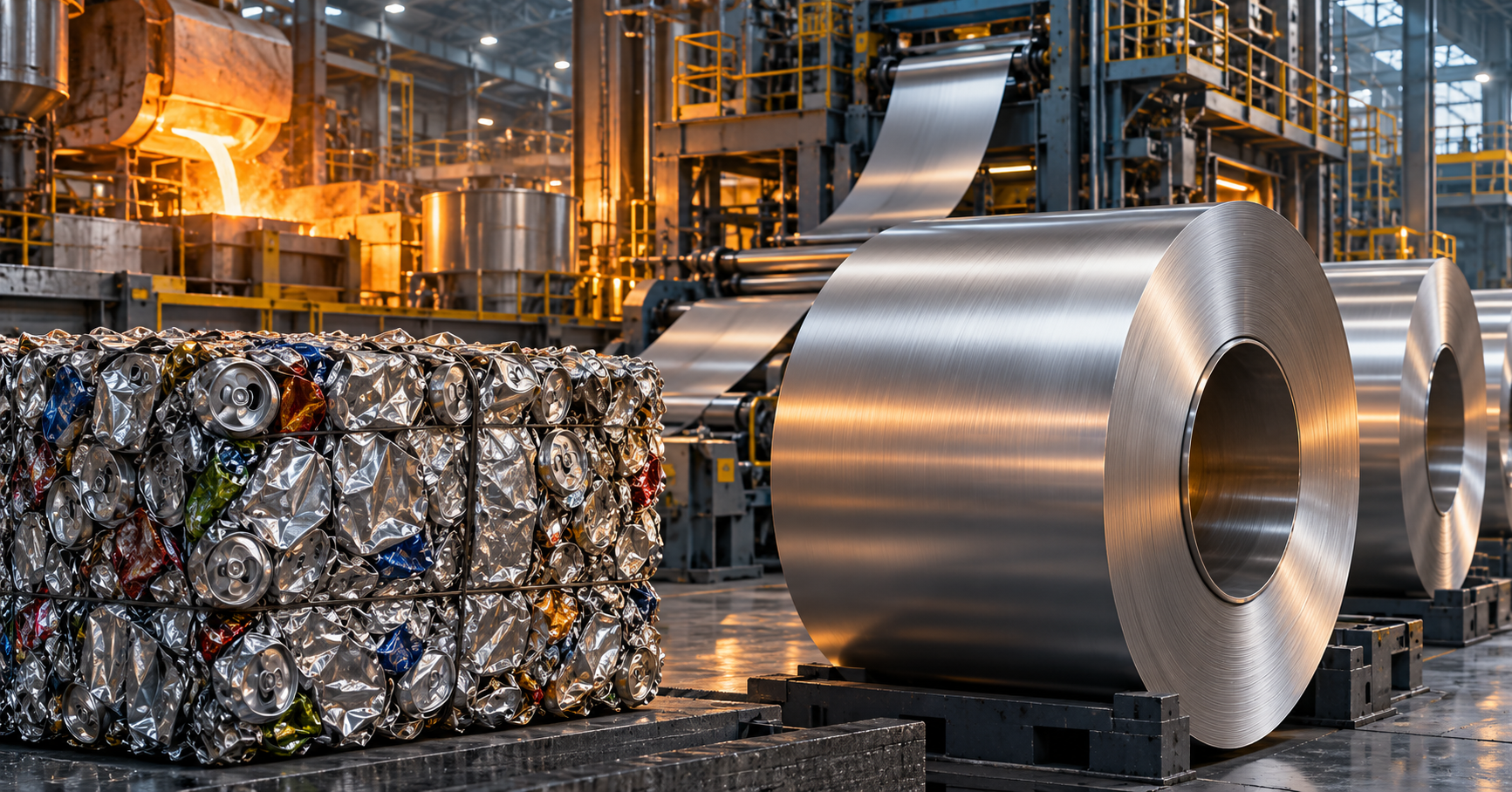
Constellium buys primary aluminum and scrap, then casts, rolls or extrudes the material into products with specific performance requirements. Rolled sheet is used in beverage cans and vehicle bodies; thicker plate and specialized alloys serve aircraft and other demanding applications. Extrusion pushes metal through a shaped die to produce profiles used in vehicle structures and industrial equipment.
Its three operating businesses serve different combinations of these markets. Packaging & Automotive Rolled Products supplies sheet and coils. Aerospace & Transportation produces higher-performance material for aviation, transportation, industry and defense. Automotive Structures & Industry supplies structural components and extruded products.
Product pricing generally combines the benchmark aluminum price, a regional metal premium and a conversion margin for processing. As explained in the June-quarter filing, Constellium seeks to pass primary-metal exposure through to customers and hedge remaining mismatches. Higher metal prices can therefore increase revenue without a corresponding increase in shipments or processing profit.
The latest quarter illustrates this effect. Revenue rose 22% year over year to $2.639 billion, while shipments declined 1% to 368,000 metric tons. More revenue per ton, including higher metal prices, accounted for the sales increase.
Accounting timing also affects the earnings comparison. Constellium’s group adjusted EBITDA includes “metal-price lag,” which arises because the metal prices reflected in customer revenue and inventory costs are established at different times. Its segment measure and annual earnings guidance exclude this effect.
Third-quarter group adjusted EBITDA of $276 million included a negative $4 million lag effect. Excluding it gives $280 million, compared with $196 million a year earlier after removing Q3 2025’s positive $39 million contribution. The comparable increase was approximately 43%, versus 17% growth in the group measure including lag. These are non-GAAP measures; net income also improved, reaching $119 million from $88 million.
Recycling drives most of the improvement
Scrap normally trades below the price of primary aluminum. The difference, known as the scrap spread, creates an opportunity to reduce input costs after allowing for collection, sorting, remelting and processing. Wider discounts and efficient recycling operations can improve earnings even when finished-product shipments decline.
Packaging & Automotive Rolled Products increased segment adjusted EBITDA to $162 million from $82 million despite a 3% shipment decline. Its $80 million increase accounted for approximately 95% of the group’s $84 million improvement in lag-excluded adjusted EBITDA after corporate costs, by AER’s calculation.
| Business | Q3 shipment change, year over year | Q3 2025 segment adjusted EBITDA | Q3 2026 segment adjusted EBITDA | Q3 2025 EBITDA per metric ton | Q3 2026 EBITDA per metric ton |
|---|---|---|---|---|---|
| Packaging & Automotive Rolled Products | −3% | $82m | $162m | $298 | $608 |
| Aerospace & Transportation | +18% | $90m | $102m | $1,796 | $1,724 |
| Automotive Structures & Industry | −4% | $33m | $21m | $683 | $454 |
The presentation attributes $70 million of the sheet business’s earnings improvement to favorable costs and $18 million to pricing and product mix. Lower volumes reduced earnings by $7 million, with currency and other effects accounting for the remaining movement. Management identifies favorable metal costs at Muscle Shoals in Alabama and Neuf-Brisach in France, including the continuing French recycling ramp, as important contributors.
Neuf-Brisach’s recycling expansion added 130,000 metric tons of annual recycling capacity. Material made mainly from post-consumer scrap subsequently qualified for use in Crown’s beverage cans, providing a commercial route for recycled output that meets customers’ manufacturing requirements.
The additional capacity creates a continuing ability to use recycled inputs. Its financial contribution still depends on scrap availability, purchase prices and manufacturing efficiency. Management expects healthy scrap conditions but cautions that North American conditions could become less favorable than in 2026. The concentration of earnings growth in this business makes that exposure consequential for the group.
Aerospace volumes rise, while costs limit the benefit
Aerospace & Transportation increased shipments by 18%, supported by improved demand for aerospace and transportation, industry and defense products. Segment adjusted EBITDA rose 13%, but profit per ton declined 4%.
The disclosed earnings bridge shows $34 million of benefit from volume and $20 million from pricing and mix, offset by $40 million of higher costs and $2 million of unfavorable currency and other effects. Additional production is generating earnings, but the cost of delivering it is preventing a proportional increase in profit.
Automotive Structures & Industry faced weaker shipments, down 4%, and a 36% decline in segment adjusted EBITDA. The comparison partly reflects customer compensation received in the prior-year quarter for an underperforming automotive program.
The regional and product differences are material. North American supply shortages supported automotive sheet deliveries within the rolled-products business, while European automotive and extrusion demand remained weak. Constellium’s current performance combines favorable conditions in selected activities with continued pressure elsewhere.
Higher profits are supporting a larger funding requirement
Operating cash flow reached $420 million through September, compared with $271 million in the same period of 2025. After $210 million of capital expenditure and $13 million of property, plant and equipment inflows, free cash flow was $223 million, up from $68 million.
That improvement came despite a larger working-capital outflow. Inventory absorbed $527 million over the nine months, while receivables used $267 million. Payables supplied $310 million, partly offsetting those demands. Including other working-capital movements, AER calculates a net cash use of $488 million, compared with $161 million a year earlier.
More expensive metal increases the value of inventory held before customers pay for finished products. Pricing arrangements may protect processing economics while leaving that funding requirement in place. Management’s cash-flow outlook explicitly allows for working-capital usage in the high-metal-price environment.
This funding demand limits how much of the earnings improvement becomes available for other purposes. Constellium maintained its annual free-cash-flow target despite raising earnings guidance.
| Measure | First nine months 2026 | Full-year guidance issued 29 July | Full-year guidance issued 28 October | Implied Q4 requirement |
|---|---|---|---|---|
| Adjusted EBITDA excluding metal-price lag | $852m | $980m–$1,020m | $1,030m–$1,060m | $178m–$208m |
| Free cash flow | $223m | Above $300m | Above $300m | Above $77m |
The earnings upgrade increases the annual midpoint by 4.5%. The revised range implies fourth-quarter lag-excluded EBITDA approximately 26%–36% below the third quarter’s $280 million. Free cash flow must exceed $77 million in the final quarter, compared with $128 million generated in the third quarter, while accommodating management’s annual spending assumptions, including approximately $330 million of capital expenditure.
The nine-month free cash flow also precedes financing allocations. During that period, Constellium spent $78 million on share repurchases and redeemed $100 million of bonds. The cash generated by the business is therefore already supporting both shareholder returns and debt reduction.
Lower leverage improves flexibility ahead of new capacity
Net debt fell to $1.658 billion at September from $1.824 billion at December 2025. Net debt was 1.6 times trailing-twelve-month segment adjusted EBITDA, including corporate costs and excluding metal-price lag, within management’s target range of 1.5–2.5 times. Both lower debt and higher trailing earnings helped reduce the ratio from 2.5 times at year-end.
September liquidity comprised $158 million of cash and $834 million of availability under lending and factoring arrangements. On 22 October, Constellium expanded its U.S. asset-based facility from $550 million to $700 million and extended maturity to 2031. The facility provides financing capacity subject to borrowing conditions, giving the business additional flexibility alongside its operating cash generation.
Investment remains important to the next stage of earnings. Management expects commercial shipments from the new Airware casthouse in Issoire to begin in early 2027, with customer qualifications underway. Airware comprises aluminum-lithium alloys designed for lightweight, high-performance aerospace structures. The project was originally scheduled to ramp in 2026, so the benefits of this additional capacity remain ahead.
The Muscle Shoals casting center is expected to start in mid-2027. Its industrial purpose includes increasing recycled input and producing more rolling ingot domestically, reducing reliance on primary metal and imported material.
Constellium’s results support a stronger assessment of its processing and sourcing economics, with lower leverage providing greater financial flexibility. If scrap-market conditions become less favorable, the new facilities and manufacturing efficiency will become more important to preserving earnings per ton. Successful customer qualification and commissioning would broaden the contribution from invested capital; narrower scrap discounts or higher operating costs would leave less cash for further debt reduction and repurchases.
This material is provided for informational and educational purposes only and does not constitute investment advice or a recommendation to buy or sell any security.
Companies Discussed
About AER Insights
Alliance Equity Research publishes timely insights on company-specific developments, industry trends, capital markets activity, and emerging investment themes across global public markets, with a particular focus on undercovered companies, sectors, and developments that often receive limited attention from mainstream financial research. Our analysis focuses on the financial, strategic, and valuation implications behind the headlines, using company disclosures, filings, market data, and sector context to help investors understand what matters, why it matters, and what to watch next.
Get AER Insights by Email
Receive new AER Insights and research updates in your inbox.
Related Insights
 Technology & Semiconductors
Corning’s Optical Growth Lifts Earnings as Customer Agreements Support Its Manufacturing Expansion
Corning’s optical-connectivity business is generating faster sales growth and higher profits as AI networks expand. Long-term customer agreements support additional manufacturing capacity, but the cash benefit includes advance payments. A slower solar ramp leaves optical profitability central to funding growth and improving shareholder returns.
 Biotechnology & Healthcare
Tango Targets First-Line Pancreatic Cancer as Larger Combination Data Support Phase 3
Tango’s larger pancreatic-cancer dataset supports further investment in its oral drug combination. A planned first-line trial would expand the clinical and commercial opportunity, while research cuts concentrate resources on PRMT5 medicines. Drug supply, dose tolerability and evidence of added benefit will determine how effectively its capital supports development.
 Industrials & Aerospace
INNIO’s Data-Center Deliveries Lift Margins as Customer Advances Help Fund Capacity Expansion
INNIO’s engine deliveries are turning data-center orders into higher equipment profits and potential maintenance revenue. Customer advances help fund its manufacturing expansion, although the cash comes with future delivery obligations. The raised annual outlook implies a fourth quarter close to the third-quarter revenue and adjusted EBITDA run rate.
 Industrials & Aerospace
GE Aerospace Raises Its Outlook as Maintenance Growth Supports Commercial Earnings
GE Aerospace’s higher annual guidance reflects stronger commercial services growth and a smaller expected GE9X earnings impact. Maintenance volume and pricing lifted commercial profit at a broadly stable margin. The remaining cash target implies faster year-over-year growth than GE delivered in the first nine months.
About Alliance Equity Research
Alliance Equity Research publishes independent and company-sponsored equity research on undercovered, emerging, and high-potential public companies globally. Our analyst-built, model-backed research combines fundamental business analysis, financial forecasting, and valuation.
Email: info@alliancekp.com · Website: https://allianceequityresearch.com
For detailed company research, financial models, or coverage inquiries, contact our research team.
Research commentary for informational purposes. This document does not constitute personalized investment advice or a Buy, Hold, or Sell recommendation. For important disclosures, including information about research sponsorship and potential conflicts of interest, visit allianceequityresearch.com/disclosures.