Atalaya’s Copper Recovery Improves as Fresh Equity Funds Its Next Growth Phase
Atalaya is extracting more copper from each tonne processed at Riotinto, supporting output without another large plant expansion. Its stronger balance sheet also reflects January’s equity raise and lower borrowings. Future returns depend on turning that funding into accessible ore and reliable processing performance.
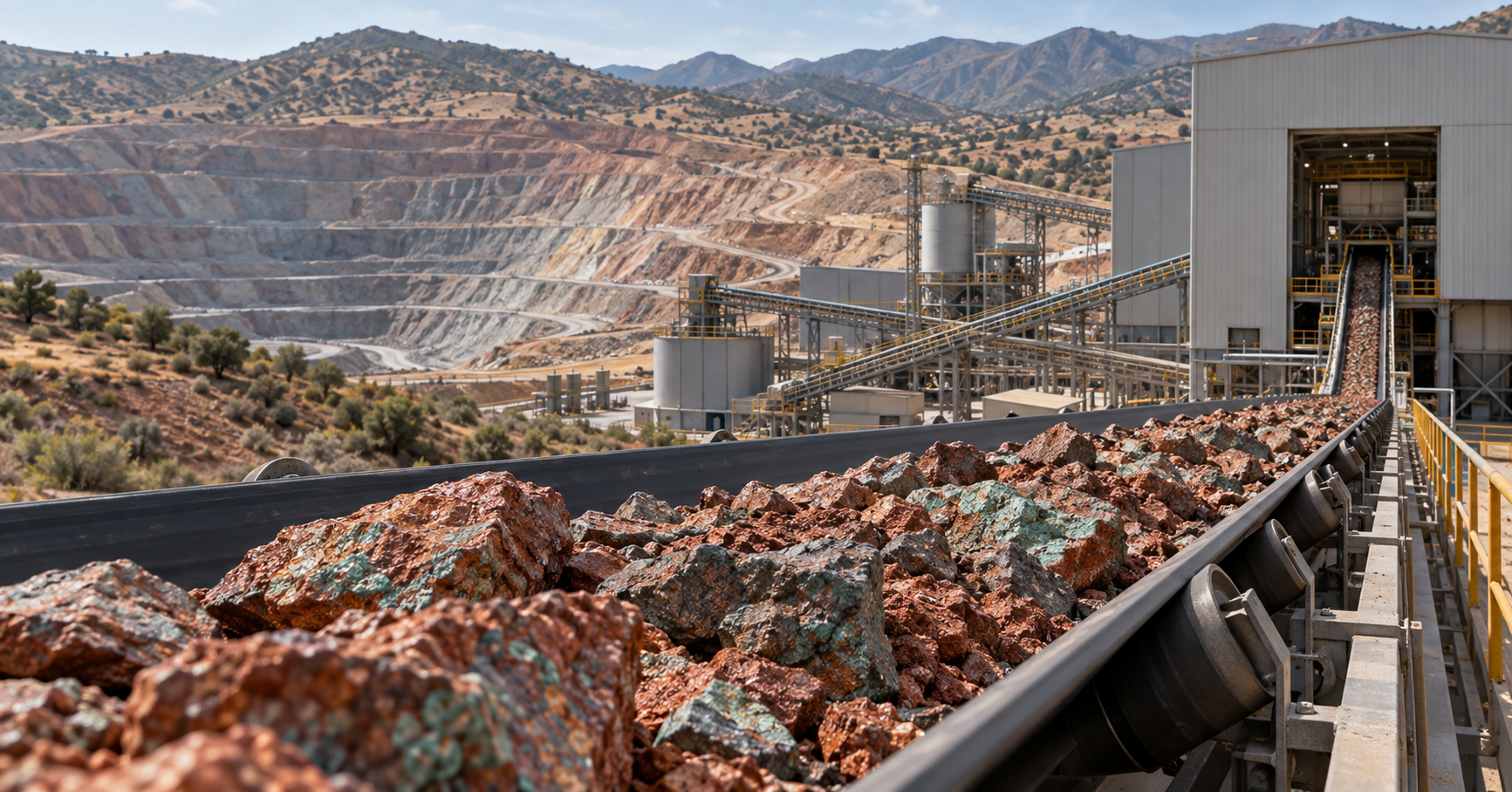
More copper from an established processing base
Atalaya Mining Copper’s October 15 operating update reported higher third-quarter copper production despite lower ore throughput than a year earlier. The improvement illustrates the value of extracting more metal from existing infrastructure as the group develops additional sources of ore.
London-listed Atalaya operates the Riotinto copper complex in southwest Spain. It mines rock, processes it into copper concentrate and earns revenue from the payable metal sold in that concentrate. Its business therefore depends on the quantity and quality of ore reaching the plant, the proportion of copper recovered and the commercial terms available for its product.
The Riotinto processing facility expanded from 9.5 million to 15 million tonnes of annual nameplate capacity following an investment approved in 2017. It has operated above that nominal capacity since reaching the expanded design rate in 2020. For Atalaya, the next production gains increasingly depend on the ore mix and processing performance within an already substantial asset base.
That creates two linked investment questions: how much additional copper can the existing plant produce, and how efficiently can the group fund and develop the deposits supplying it?
Recovery is improving the yield from each tonne
The latest production comparison shows how throughput alone can obscure operating progress. Grade measures the copper content of the ore entering the plant; recovery measures the share of that copper captured during processing.
| Riotinto operating measure | Q3 2025 | Q3 2026 |
|---|---|---|
| Ore processed | 4.3 million tonnes | 4.1 million tonnes |
| Copper grade | 0.38% | 0.40% |
| Copper recovery | 74.45% | 84.25% |
| Copper produced | 12,123 tonnes | 13,967 tonnes |
Using these reported figures, AER calculates that output rose 15.2%, while throughput fell approximately 4.7%. Recovered copper per tonne processed increased from approximately 2.82 kilograms to 3.41 kilograms, a gain of about 21%. Throughput is rounded in the announcement, so the yield comparison is approximate.
Higher recovered yield can spread processing expenditure across more saleable metal. It also reduces the pressure to secure every increment of growth by expanding crushing and milling capacity. The benefit to unit costs will depend on the additional energy, reagents and maintenance required to achieve that recovery.
This is an operating outcome worth tracking across several quarters. Ore characteristics affect metallurgical performance, so a better recovery rate cannot automatically be assigned to equipment improvements or assumed to persist as different deposits enter the blend.
Shareholders supplied part of the growth capital
Atalaya strengthened its funding position before the latest operating improvement. Its January 28 fundraising announcement recorded the issue of 13 million shares at £10 each, raising £130 million gross. Institutional investors subscribed £127.3 million and the retail offer supplied £2.7 million.
The new shares increased the pre-offer share count by approximately 9.2%, taking the announced post-admission total to 153.76 million. On that basis, an existing shareholder who did not participate retained approximately 91.5% of their previous proportional ownership, equivalent to about 8.5% dilution.
Management earmarked the proceeds for accelerating Spanish copper projects and providing flexibility over the eventual funding package for Touro. The economic hurdle is consequently a return on newly supplied shareholder capital as well as on cash generated by the existing operation.
Raising capital ahead of expenditure gives Atalaya room to sequence projects and negotiate financing. It also starts the period during which shareholders have supplied cash without yet receiving the associated production. Development schedules and capital discipline will determine how productive that interval becomes.
Cash balances and net cash tell different parts of the story
The first-half financial statements provide a complete bridge to June’s cash balance. Figures below are rounded to €0.1 million.
| First-half 2026 cash bridge | € million |
|---|---|
| Opening cash | 166.3 |
| Operating cash inflow | 108.6 |
| Investing cash outflow | (50.0) |
| Financing cash inflow | 132.1 |
| Foreign-exchange effect | (6.7) |
| Closing cash | 350.3 |
Operating cash exceeded investing outflows by €58.6 million. Financing included €145.1 million of net share-issuance proceeds, offset principally by net borrowing repayments and other financing payments. The investing total includes financial investments alongside mine and plant expenditure.
By September, reported cash was €354.1 million and net cash €342.1 million. Against June, cash increased approximately €3.8 million and net cash €23.8 million, implying a roughly €20 million reduction in borrowings. Net cash excludes lease liabilities; September’s rounded figures leave a €0.1 million subtraction difference.
The strengthening balance sheet gives Atalaya more capacity to absorb development spending. The quarterly movement also shows why an increase in net cash cannot be read directly as free cash flow: repayment of borrowing changes both cash and debt, while the operating and investing statements are needed to establish cash generation.
Accessing richer ore brings mining and metallurgical requirements
The nearby San Dionisio deposit is wholly owned and contains both copper-rich stockwork and polymetallic mineralisation. Stockwork describes mineralisation distributed through a network of veins; polymetallic ore contains several potentially recoverable metals, including copper, zinc and lead. These ore types can require different processing approaches.
Atalaya’s current update identifies delayed power-line relocation as a constraint on San Dionisio stripping. Removing waste rock is necessary to expose ore, making utility coordination part of the production schedule.
The distinction between ore types also affects how much value can be obtained from the existing plant. The February 2023 Riotinto preliminary economic assessment described additional grinding and flotation requirements for polymetallic material. Flotation separates mineral particles into concentrates; finer grinding can help release those minerals from surrounding rock, while increasing processing complexity and energy demand.
That study recommended further metallurgical testing and a blending model to optimise recovery and cash flow. Its engineering discussion explains why higher in-ground metal content alone is insufficient to establish a better return. The plant must recover the metals into products that can be sold economically, after accounting for processing expenditure and additional equipment.
For the existing shareholders who financed expansion, the next useful evidence is specific: progress on ore access, a sustained recovered yield as the feed blend changes, and updated capital requirements supported by engineering. Subsequent financial results should then show how much operating cash remains after development expenditure and working-capital movements. Those measures will establish whether Atalaya’s larger funding base is translating into more productive capacity.
This material is provided for informational and educational purposes only and does not constitute investment advice or a recommendation to buy or sell any security.
About AER Insights
Alliance Equity Research publishes timely insights on company-specific developments, industry trends, capital markets activity, and emerging investment themes across global public markets, with a particular focus on undercovered companies, sectors, and developments that often receive limited attention from mainstream financial research. Our analysis focuses on the financial, strategic, and valuation implications behind the headlines, using company disclosures, filings, market data, and sector context to help investors understand what matters, why it matters, and what to watch next.
Get AER Insights by Email
Receive new AER Insights and research updates in your inbox.
Related Insights
 Industrials & Aerospace
Schneider’s Data-Center Growth Supports a Software Expansion With Demanding Acquisition Economics
Schneider Electric has raised its outlook again as demand for data-center power and cooling equipment strengthens. Its proposed PTC acquisition would extend the business into product engineering software, but the purchase economics depend on earnings benefits that exceed the identified cost savings.
 Capital Markets & M&A
Transocean’s Larger Credit Line Links Financing Flexibility to the Valaris Merger
Transocean has retired expensive secured debt and arranged a larger revolving facility that depends on completing its Valaris acquisition. The developments improve its financing options, but lasting balance-sheet progress will depend on converting contracted drilling work into cash while absorbing the combined fleet.
 Mining & Critical Minerals
SSR Mining’s Roxmore Deal Secures a Longer Runway for Its Nevada Operations
SSR Mining’s proposed acquisition of Roxmore adds a neighbouring gold development project to its Nevada portfolio. Existing cash supports the purchase, while the eventual return depends on permitting, construction costs and coordinating future production with the established Marigold operation.
 Mining & Critical Minerals
Ivanhoe’s Copper Recovery Gains Support From Acid Sales and Solar Power
Kamoa-Kakula’s latest operating update shows how local acid demand and a changing power supply can influence copper margins. Understanding the benefit requires following the project from underground ore through processing, sales and the costs of its continuing recovery.