Schneider’s Data-Center Growth Supports a Software Expansion With Demanding Acquisition Economics
Schneider Electric has raised its outlook again as demand for data-center power and cooling equipment strengthens. Its proposed PTC acquisition would extend the business into product engineering software, but the purchase economics depend on earnings benefits that exceed the identified cost savings.
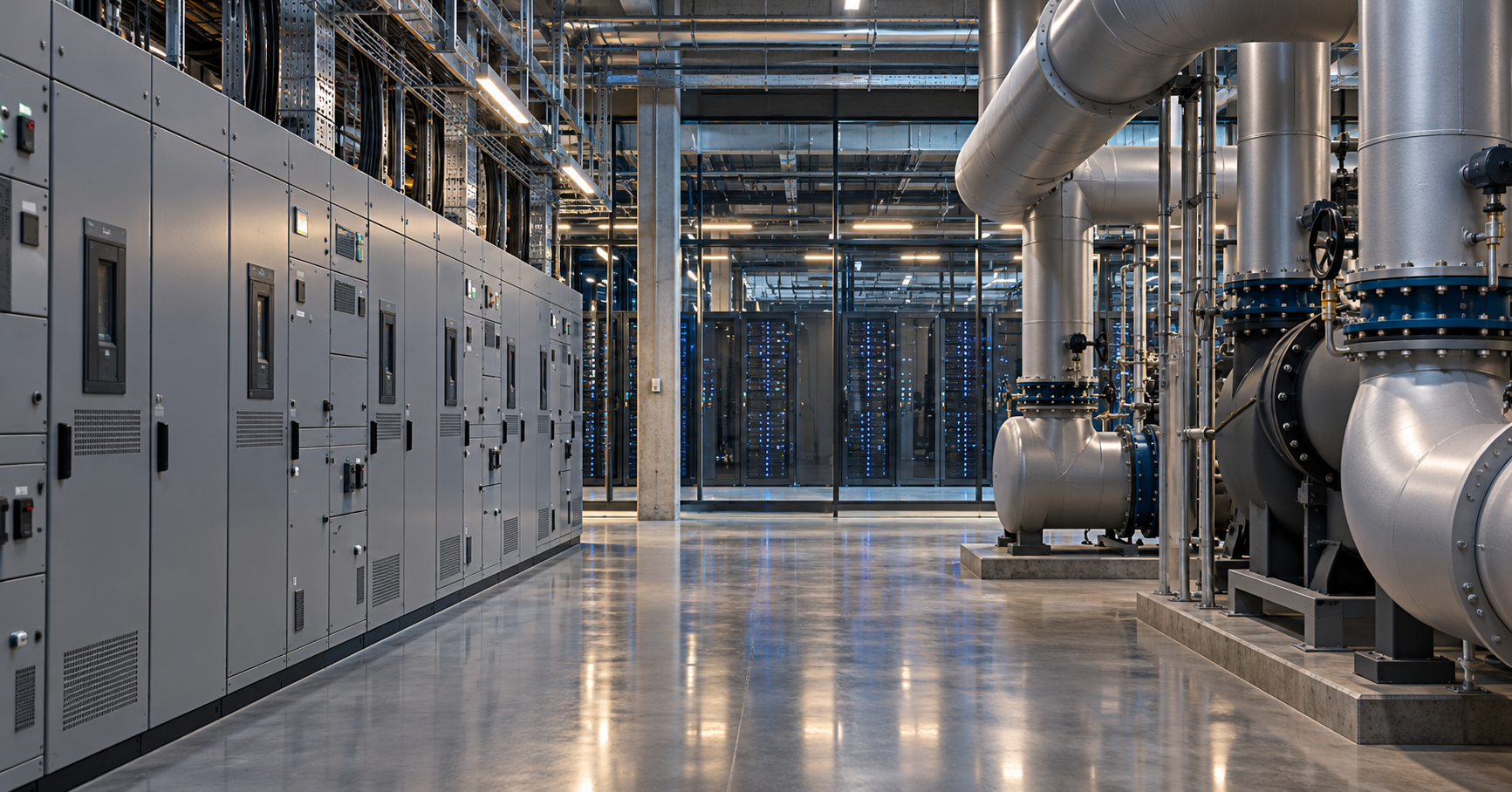
Electrical infrastructure is supplying the current growth
Schneider Electric’s October 16 results reported third-quarter revenue of €11.46 billion, up 16.9% organically from a year earlier. Management raised its full-year outlook for both revenue and adjusted operating earnings. The announcement follows its agreement to acquire PTC, placing an expanding electrical infrastructure business alongside a proposed investment in industrial software.
Schneider sells equipment, systems, software and services used to distribute electricity and operate buildings, factories and infrastructure. A data-center customer, for example, needs electrical protection, reliable backup power and cooling before its servers can operate. Schneider earns revenue from supplying that equipment, integrating systems and providing software and ongoing services.
Its two reporting businesses serve these needs from different directions. Energy Management covers electrical infrastructure and associated technologies; Industrial Automation helps customers control and manage industrial operations. Data centers are an end-market served by the portfolio, alongside buildings, industry and infrastructure.
The distinction helps explain the investment opportunity. Schneider participates in the physical spending required to install computing capacity, while its software expansion seeks a larger role in how customers design and operate industrial assets. These activities have different sales cycles, funding requirements and competitive economics.
Understanding what customers are buying
The quarterly presentation provides another view of the business through three revenue categories. These describe how Schneider sells its offerings across its reporting businesses.
| Business model | Share of Q3 company revenue | Q3 organic revenue growth versus Q3 2025 |
|---|---|---|
| Products | 48% | 17% |
| Systems | 35% | 22% |
| Software & Services | 17% | 7% |
| Total | 100% | 16.9% |
Products include individual electrical and automation devices. Systems combine equipment into larger installations, including prefabricated power infrastructure, backup-power systems and cooling. Software & Services includes digital offerings and field work such as installation, commissioning and maintenance. The growth rates measure changes in sales; the shares describe each category’s contribution to current revenue.
Products and Systems together account for 83% of quarterly revenue. The fastest-growing category was Systems, linking current expansion to customers installing infrastructure. Software & Services includes field services, so its 17% share also contains work supporting physical equipment.
Separately, the presentation shows Data Center & Networks representing 30% of 2025 orders. That is a customer-market measure for a different period and denominator. It should be read as historical exposure to that market, alongside the current revenue mix.
Orders create visibility, while delivery determines revenue timing
On the results call, management described triple-digit data-center order growth in three of the past four quarters. Some of that work extends into 2027 and 2028. Schneider did not provide a detailed schedule showing when the backlog would become revenue.
This creates an operating dependency: production capacity and customer construction schedules determine how quickly orders translate into sales. Management described investment in liquid cooling and prefabricated infrastructure, including capacity supplied through partners. Prefabrication assembles equipment before delivery, reducing installation work at the customer’s site.
The commercial advantage is participation earlier in project design. A supplier helping specify the power architecture can sell several connected components and support installation. The financial benefit depends on delivering those projects at acceptable costs while managing the inventory and receivables needed to support them.
Pricing also contributes to current growth. Management said the value of third-quarter pricing benefits matched the entire first half, following successive pricing actions. Those increases respond partly to input-cost inflation. The amount retained after materials, transport and tariffs will determine how much pricing contributes to earnings.
Higher guidance still allows growth to moderate
The revised full-year targets call for 12%–14% organic revenue growth and 18%–21% organic growth in adjusted EBITA, an operating earnings measure before interest, tax and amortization, with company-defined adjustments. Schneider expects an adjusted EBITA margin of approximately 19.7%–19.9%. Nine-month revenue growth was already 15% organically, placing the annual sales range below the year-to-date pace.
The annual outlook therefore accommodates slower fourth-quarter growth. On the call, management pointed to the stronger prior-year comparison and the range of business conditions considered in its forecast. An exact fourth-quarter euro requirement cannot be obtained by applying the organic growth target directly to reported historical revenue: the calculation also requires comparable exchange-rate and consolidation adjustments.
The 2025 results provide context for that comparison. Fourth-quarter revenue was €11.10 billion, with organic growth of 10.7%. Schneider is now comparing against an already expanding business. The relevant question is how much of the order book can be delivered while preserving profitability as pricing and input costs change.
Cash generation improves, but acquisitions expand the funding requirement
Schneider’s first-half accounts show the cash requirements behind growth. Cash generated before working-capital movements was €3.755 billion. Trade working capital absorbed €1.208 billion and other working-capital movements absorbed €247 million, leaving €2.300 billion from operating activities. Net investment in operating assets of €669 million reduced that to €1.631 billion of free cash flow.
Inventory and customer payments therefore influence how much of the expanding business becomes available to fund acquisitions or repay debt. At June 30, financial liabilities of €19.390 billion less cash of €4.518 billion produced net financial debt of €14.872 billion. Including €488 million of purchase commitments over minority interests brought the company’s broader net-debt measure to €15.360 billion. These are June balances, preceding the PTC agreement.
The PTC announcement envisages approximately €5 billion–€6 billion of equity issuance and €16 billion–€17 billion of new debt financing. PTC supplies product design, engineering and data-management software, extending Schneider’s reach into customers’ product development.
The announced €21.1 billion enterprise value was presented as 21 times estimated 2027 adjusted EBITA, falling to 13 times with full run-rate synergies. AER’s arithmetic illustrates the earnings dependency:
| Calculation from rounded announced figures | Approximate annual adjusted EBITA |
|---|---|
| €21.1 billion ÷ 21 | €1.0 billion |
| €21.1 billion ÷ 13 | €1.6 billion |
| Implied additional earnings | €0.6 billion |
Identified cost synergies of €250 million cover roughly two-fifths of that implied increment. The remaining benefit depends on other earnings contributions, including the profitability of approximately €800 million of expected revenue synergies. These are management expectations; the rounded multiples describe a fully realized combination, with benefits arriving over time.
Schneider’s existing operations provide a growing earnings base for this expansion. Its first-half results reported adjusted EBITA of €4.093 billion at a 19.3% margin. They also showed that free cash flow remains sensitive to working capital and expenditure timing, making continued cash conversion relevant to financing capacity.
The next full-year results are scheduled for February 18, 2027. The useful evidence will be the cash retained from higher sales, the margin achieved after inflation and tariffs, and the financing terms for the proposed acquisitions. Schneider also expects to pause buybacks in 2027 and 2028, directing more financial capacity toward its expansion.
This material is provided for informational and educational purposes only and does not constitute investment advice or a recommendation to buy or sell any security.
About AER Insights
Alliance Equity Research publishes timely insights on company-specific developments, industry trends, capital markets activity, and emerging investment themes across global public markets, with a particular focus on undercovered companies, sectors, and developments that often receive limited attention from mainstream financial research. Our analysis focuses on the financial, strategic, and valuation implications behind the headlines, using company disclosures, filings, market data, and sector context to help investors understand what matters, why it matters, and what to watch next.
Get AER Insights by Email
Receive new AER Insights and research updates in your inbox.
Related Insights
 Capital Markets & M&A
Transocean’s Larger Credit Line Links Financing Flexibility to the Valaris Merger
Transocean has retired expensive secured debt and arranged a larger revolving facility that depends on completing its Valaris acquisition. The developments improve its financing options, but lasting balance-sheet progress will depend on converting contracted drilling work into cash while absorbing the combined fleet.
 Mining & Critical Minerals
Atalaya’s Copper Recovery Improves as Fresh Equity Funds Its Next Growth Phase
Atalaya is extracting more copper from each tonne processed at Riotinto, supporting output without another large plant expansion. Its stronger balance sheet also reflects January’s equity raise and lower borrowings. Future returns depend on turning that funding into accessible ore and reliable processing performance.
 Industrials & Aerospace
Volution’s Acquisition Strategy Is Broadening Its Markets and Increasing Its Funding Needs
Volution’s latest results show how a ventilation manufacturer can grow through acquisitions while improving operating margins. Expansion into mining and European heat recovery adds new customers, but acquisition payments are absorbing cash and increasing the importance of returns on invested capital.
 Industrials & Aerospace
AAR’s $4 Billion MRO Holdings Deal Is Really a Bet on Aircraft Scarcity
AAR is acquiring 65% of MRO Holdings in a transaction that would increase its revenue by more than 30% and lift pro forma adjusted EBITDA margins from roughly 12% to 16% before synergies. The strategic logic rests on a less obvious aviation constraint: delayed aircraft replacement is increasing the maintenance burden on an aging global fleet, while skilled labor and hangar capacity remain difficult to add quickly.