Ivanhoe’s Copper Recovery Gains Support From Acid Sales and Solar Power
Kamoa-Kakula’s latest operating update shows how local acid demand and a changing power supply can influence copper margins. Understanding the benefit requires following the project from underground ore through processing, sales and the costs of its continuing recovery.
A copper producer with a second source of income
Ivanhoe Mines’ October 8 operating update reported 76,401 tonnes of copper in saleable products at Kamoa-Kakula in the third quarter, up 18.8% sequentially. Its smelter also realized approximately $900 per tonne for sulphuric acid. That additional product gives the operation another source of income as copper production recovers.
Ivanhoe is a listed mining company with interests in African mineral projects. At Kamoa-Kakula in the Democratic Republic of the Congo, it owns 39.6%, alongside Zijin Mining’s 39.6%, the government’s 20% and Crystal River’s 0.8%. The operating figures discussed here cover the entire project; all dollar amounts are US dollars.
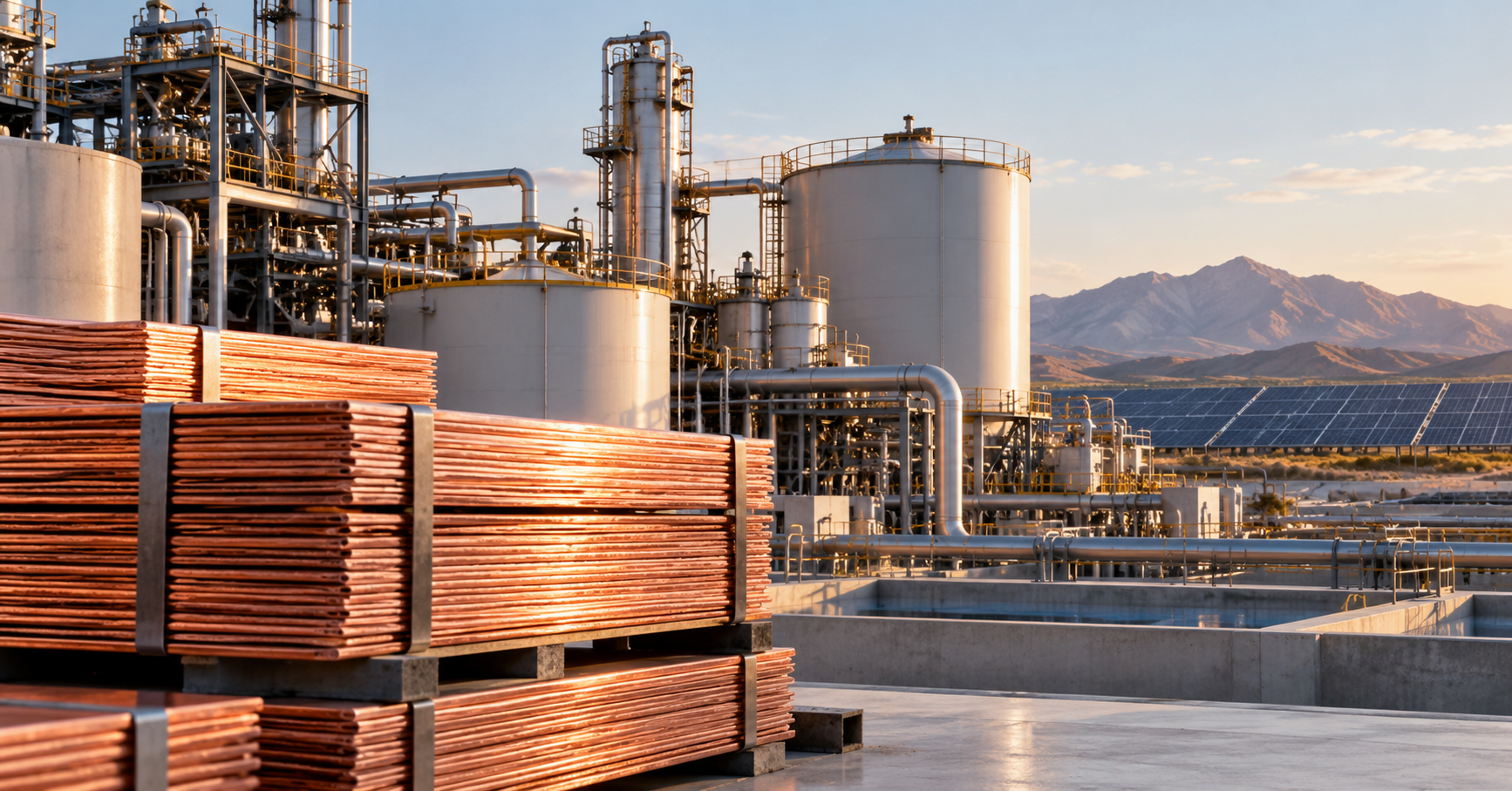
The complex mines ore, concentrates its copper content and processes concentrate into high-purity metal for sale. Its on-site smelter began operating in late 2025 and produces copper that can be cast into anodes for further refining. Customers buying metal and customers buying the smelter’s acid create two revenue streams from the processing chain.
Why the recovery still shapes the business
Kakula suffered seismic activity and partial flooding in May 2025. Restoring production required pumping out water, rehabilitating underground infrastructure and reopening access. That history explains why available ore and mine development remain central to the investment case.
Underground development creates the tunnels and services needed to reach future mining areas. In its July operating report, Ivanhoe described work around Kakula’s lower-grade periphery before extraction could begin in newly developed, higher-grade areas. During this transition, processing more rock can require additional expenditure for each tonne of copper recovered.
The latest quarter produced 68,188 tonnes of copper in concentrate, up 11.5%. Saleable output also included 6,904 tonnes of previously stockpiled copper fines newly designated for sale. These figures track different stages and material movements through the operation and overlap. Concentrate output provides a useful measure of the recovery in freshly processed ore.
Acid connects the smelter to neighbouring mines
Sulphuric acid is a saleable by-product of the smelting process. Nearby mining operations buy it at Kamoa-Kakula’s mine gate, giving the by-product a commercial outlet close to production.
The first-quarter financial results show the scale already achieved: 107,700 tonnes sold to six buyers at an average $467 per tonne, contributing approximately $50 million of revenue. Multiplying the disclosed volume and rounded price gives $50.3 million, consistent with that reported contribution.
Acid therefore enters the copper economics through an established sales channel. Higher prices can improve the return from processing each batch of concentrate, although the benefit depends on volumes sold, customer demand and collections. For valuation, a durable customer base and repeatable sales volumes deserve separate attention from a particularly favourable quarter’s selling price.
Following the cash-cost bridge
Ivanhoe’s second-quarter financial results show how acid credits enter C1 cash costs, a non-IFRS operating-cost measure expressed per payable pound of copper produced. Capital expenditure, financing costs and taxes sit outside this measure.
| US dollars per payable pound | Q1 2026 | Q2 2026 |
|---|---|---|
| Mining | 1.39 | 1.46 |
| Processing | 0.59 | 0.69 |
| Smelter operations | 0.27 | 0.41 |
| Logistics | 0.22 | 0.24 |
| Refining and treatment | 0.12 | 0.08 |
| General and administrative | 0.31 | 0.35 |
| Sulphuric acid credit | (0.32) | (0.39) |
| C1 cash cost | 2.58 | 2.84 |
The Q2 acid credit covered about 95% of smelter operating costs: $0.39 divided by $0.41. Across the whole operation, costs before the credit increased $0.33 per pound; the additional $0.07 credit left a $0.26 increase in C1. Q1 also benefited from partial capitalization of smelter operating costs, affecting the comparison.
This bridge illustrates the investment sensitivity. Acid can support margins while mining and processing expenses move in the opposite direction. A forecast that links copper profitability only to the copper price would miss both influences, especially during an operational recovery.
Power changes another part of the equation
The solar facilities described in July combine solar generation with battery storage to supply continuous power. CrossBoundary Energy and Green World Energie own, fund and operate them, with Kamoa Copper purchasing the electricity. This structure places the generating assets with specialist providers while the mine pays for supply.
By September 23, the facilities had reached their combined 60-megawatt continuous output. Generator diesel consumption in September was 40% below July, as disclosed in the October update. The reduction applies specifically to the generators.
For a recovering underground operation, dependable electricity has operational value as well as a fuel-cost effect. Pumping and processing need continuity; interruptions can delay work and reduce the output over which operating costs are spread. The financial benefit will depend on purchased-power tariffs, diesel savings and operating availability together.
Evidence to watch in the next results
The next financial disclosure should show how acid sales translated into the by-product credit and whether power changes reduced unit costs. Copper shipments, inventory movements and cash collections will help establish how much of the operating improvement reached cash flow.
Management currently expects production toward the lower end of its 290,000–310,000-tonne full-year range. For the mine itself, progress into higher-grade areas and sustained concentrate output remain the measures to follow. Those results will determine how effectively Kamoa-Kakula can use its processing infrastructure while retaining the additional income available from acid sales.
This material is provided for informational and educational purposes only and does not constitute investment advice or a recommendation to buy or sell any security.
About AER Insights
Alliance Equity Research publishes timely insights on company-specific developments, industry trends, capital markets activity, and emerging investment themes across global public markets, with a particular focus on undercovered companies, sectors, and developments that often receive limited attention from mainstream financial research. Our analysis focuses on the financial, strategic, and valuation implications behind the headlines, using company disclosures, filings, market data, and sector context to help investors understand what matters, why it matters, and what to watch next.
Get AER Insights by Email
Receive new AER Insights and research updates in your inbox.
Related Insights
 Special Situations
Exail’s Thales Takeover Brings Its Earlier Acquisition Financing Back Into Focus
Exail’s revised accounts bring obligations from its 2022 expansion into focus as Thales pursues a €134-per-share takeover. Its maritime robotics and navigation businesses are growing, while settlement rights held by ICG and employees add complexity to the acquisition’s financial structure.
 Mining & Critical Minerals
Caledonia’s Lower Gold Guidance Still Requires a Sharp Fourth-Quarter Recovery at Blanket
Caledonia has reduced its 2026 production outlook and raised unit-cost guidance after equipment and processing problems at Blanket. The revised target still assumes a fourth-quarter recovery, while deferred capital expenditure provides near-term cash relief without reducing the underlying investment requirement.
 Biotechnology & Healthcare
Viatris’s Pacira Deal Buys Established Pain Medicines, but Growth Must Justify the Price
Viatris’s $1.65 billion cash offer adds two marketed non-opioid pain medicines and a U.S. commercial platform. The investment case depends on product durability, international expansion and cash returns, with Pacira’s debt, recent divestiture and adjusted earnings complicating a simple acquisition-multiple comparison.
 Mining & Critical Minerals
Nth Cycle’s $1 Billion Glencore Deal Addresses Demand, but Leaves Its Funding Test Unfinished
Glencore’s proposed feedstock and offtake arrangements strengthen Nth Cycle’s commercial case ahead of its planned SPAC merger. Converting that demand into shareholder value still requires definitive contracts, construction funding and profitable refinery operations.