Xanadu’s GlobalFoundries Partnership Moves Quantum Computing Toward Manufacturing, With Economics Still Unproven
A 300 mm foundry partnership addresses the production of photonic chips and detectors needed for Xanadu’s planned quantum systems. The investment case now depends on translating component performance into manufacturing yields, integrated demonstrators and commercially useful machines while controlling development spending.
A manufacturing pathway becomes more concrete
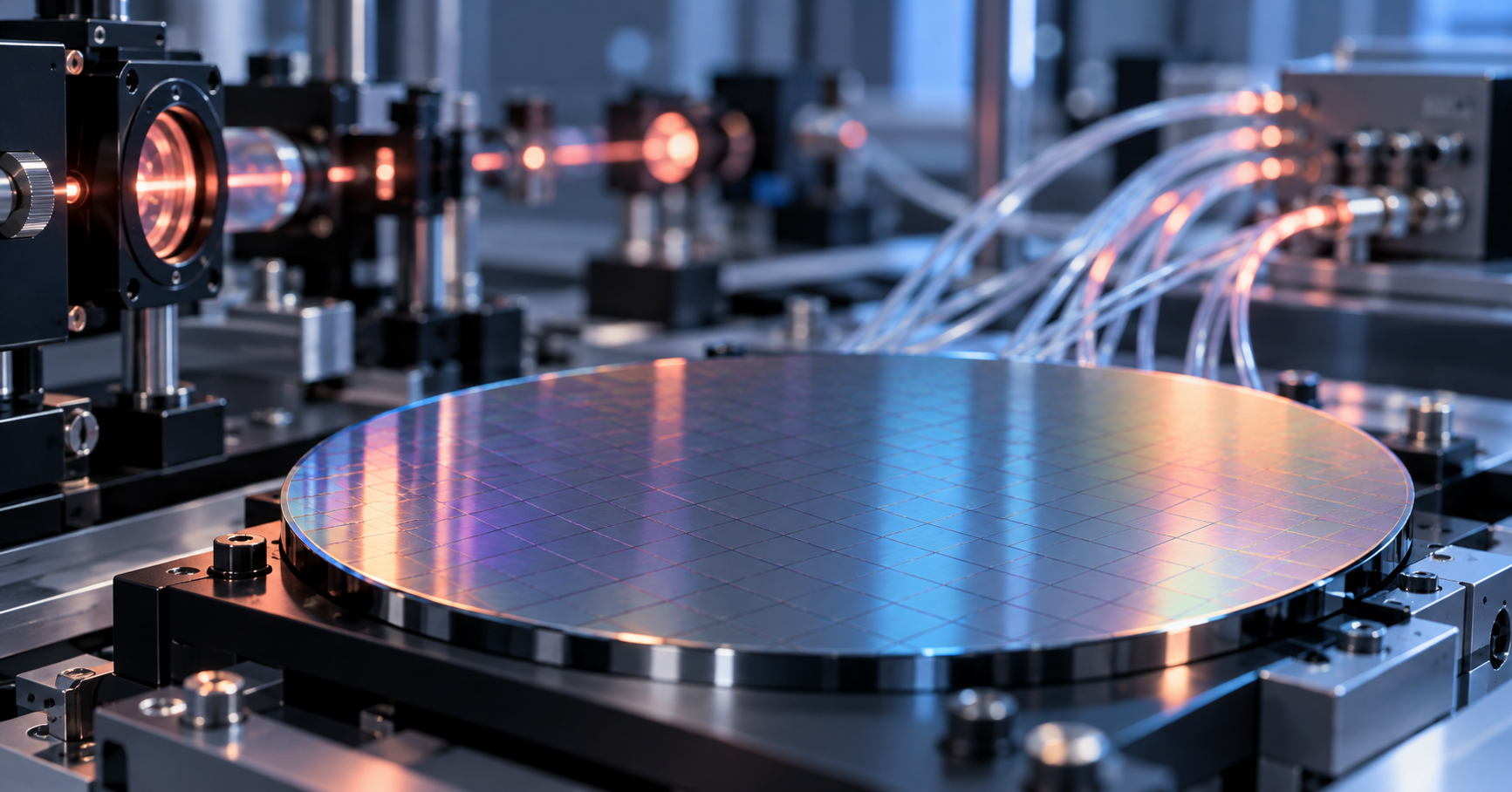
Xanadu’s October 6 partnership with GlobalFoundries gives the photonic quantum-computing developer a route toward producing components on a commercial semiconductor line. The multi-year collaboration initially targets ultra-low-loss silicon nitride photonics and superconducting nanowire single-photon detectors through GlobalFoundries’ 300 mm operation in Malta, New York. Its intended output will support Xanadu’s future fault-tolerant demonstrators.
For shareholders, the agreement connects laboratory engineering to manufacturing infrastructure. It also moves the assessment of progress toward questions familiar to semiconductor investors: reproducibility, yield, packaging and cost per usable component. The announcement does not disclose contract value, minimum purchases, production volumes or a commercial-system delivery date, leaving the financial contribution unquantified.
GlobalFoundries provides a manufacturing platform; Xanadu must demonstrate that its designs can retain their required performance on that platform. A successful transfer could reduce production uncertainty, but the resulting investment value will depend on whether the components work economically together in a complete system.
Wafer scale needs to translate into usable systems
A larger production platform creates an opportunity to spread manufacturing effort across more components. The economic benefit depends on the proportion that meets specification and on the cost of assembling those components into working modules. Manufacturing more chips offers limited benefit if optical losses, detector performance or packaging defects prevent a system from completing useful calculations.
Xanadu’s peer-reviewed Aurora demonstration, published in January 2025, helps define the remaining technical gap. The machine used 35 photonic chips and 36 photon-number-resolving detectors, furnishing 12 physical qubit modes per clock cycle. The paper demonstrated modular networking and building blocks for fault tolerance while identifying optical loss as the dominant hurdle to crossing the fault-tolerant threshold.
That distinction is economically relevant. Adding components can increase engineering, testing and installation costs before it delivers useful computing capacity. Progress toward lower losses and reliable manufacturing therefore needs to be assessed alongside system performance, not solely through chip counts or wafer diameter.
The foundry partnership could create a better testing environment for those trade-offs. Repeated production runs would allow Xanadu to measure whether improvements are consistent across batches and whether the cost of achieving them declines. Those results would provide a firmer basis for estimating future system economics than an isolated laboratory record.
Cooling remains part of the infrastructure bill
The production agreement follows Xanadu’s September 29 collaboration with Bluefors. That multi-million-dollar development program targets a modular cryogenic prototype for single-photon detectors, with the disclosed design objective including operation near 2 Kelvin. The partners intend to develop a mass-manufacturable module and potentially remove the need for traditional industrial-scale cryoplants.
Photonic computing can use room-temperature components while still requiring cryogenic detection. The commercial assessment must consequently include cooling equipment, optical connections, packaging and system maintenance alongside chip fabrication. A simplified cooling module could improve installation flexibility, but the announcement provides no verified savings per machine or operating-cost comparison.
Together, the two partnerships address complementary engineering requirements. Foundry production tackles component supply and consistency; cooling development tackles deployment of the detector subsystem. Neither announcement alone establishes the cost of a delivered quantum-computing system, and gains in one subsystem must survive integration with the others.
Development spending remains far ahead of revenue
Xanadu’s second-quarter results show the scale of the development effort. The figures below are in U.S. dollars and describe the quarter ended June 30, 2026, with cash measured at quarter-end.
| Metric | Q2 2026 |
|---|---|
| Revenue | $1.511 million |
| Research and development expense | $19.723 million |
| GAAP net loss | $42.051 million |
| Adjusted EBITDA loss | $21.333 million |
| Cash and cash equivalents | $312.780 million |
R&D expense was approximately 13 times quarterly revenue. Revenue rose from $1.057 million a year earlier, with growth primarily driven by DARPA Stage B revenue, but remains insufficient to fund the engineering program. Partnerships that increase wafer runs and development activity may raise spending before they generate commercial receipts.
The GAAP-to-adjusted reconciliation includes $12.504 million of financial-instrument fair-value adjustments and $4.678 million of stock-based compensation, among other adjustments. Adjusted EBITDA measures a different expense base from GAAP net loss and is not a cash-flow measure. Its smaller loss still shows that recurring development economics require considerable improvement.
For now, technical milestones and spending discipline offer more information about the investment case than a conventional earnings multiple. The useful comparison is between the capital consumed and the performance, reliability and commercial readiness gained with that capital.
Financing buys time, with dilution attached
The June cash balance was supported by external financing. Xanadu’s filed cash-flow statement reports $334.236 million of net financing inflows in the first half, against $30.630 million used in operations and $7.160 million used in investing. Including the $0.170 million exchange-rate effect, those movements reconcile opening cash of $16.164 million to $312.780 million.
Within the financing effort, Xanadu raised $67.2 million through its synthetic at-the-market facility, selling approximately 5.5 million shares at an average net price of $12.28. The facility permits up to $300 million of issuance over three years. That ceiling is financing capacity subject to its terms, not additional cash already received.
Future equity issuance spreads the value of any technical success across more shares. Conversely, reaching reproducible manufacturing and integrated-system milestones before further fundraising could improve the terms on which capital is available. The June balance is a historical liquidity snapshot; extrapolating a fixed runway from first-half cash use would overlook the potential cost of the next development stage.
What would make the agreement investable
The next disclosures should connect manufacturing activity to demonstrable system progress. Batch-level consistency, usable-component yields and integrated detector performance would help establish whether foundry access is improving the probability and cost of reaching a commercial machine. Cash expenditure and financing needs should be evaluated against those achievements.
Customer evidence also needs to advance. Paid development work supports engineering, while repeat purchases for useful computing applications would provide a different level of commercial validation. Revenue quality, delivery obligations and the capital required to fulfil contracts will determine how much technical progress eventually reaches shareholders.
Xanadu has added a credible industrial partner to a development program with cash available at its latest reporting date. The valuation case will become easier to substantiate when manufacturing, cooling and fault-tolerant performance can be assessed together, with disclosed costs and customer demand. Until then, the partnership improves the route to execution while leaving the returns on that route open.
This material is provided for informational and educational purposes only and does not constitute investment advice or a recommendation to buy or sell any security.
About AER Insights
Alliance Equity Research publishes timely insights on company-specific developments, industry trends, capital markets activity, and emerging investment themes across global public markets, with a particular focus on undercovered companies, sectors, and developments that often receive limited attention from mainstream financial research. Our analysis focuses on the financial, strategic, and valuation implications behind the headlines, using company disclosures, filings, market data, and sector context to help investors understand what matters, why it matters, and what to watch next.
Get AER Insights by Email
Receive new AER Insights and research updates in your inbox.
Related Insights
 Energy
Energy Transfer’s $2.6 Billion Vaquero Deal Buys Volumes for Its Wider Network
The acquisition adds contracted Delaware Basin gas-processing capacity already connected to Energy Transfer’s downstream infrastructure. Returns will depend on capturing additional transportation and export fees while funding a cash-heavy purchase alongside an expanding construction program.
 Biotechnology & Healthcare
Vaxcyte’s Phase 3 Success Advances a Broader Vaccine Toward Its Next Regulatory Tests
VAX-31 passed every primary endpoint in its pivotal adult trial, supporting a broader pneumococcal vaccine profile. Individual comparator results, remaining manufacturing studies and rising development spending will shape the path to Vaxcyte’s planned 2028 filing and eventual commercial opportunity.
 Technology & Semiconductors
Micron’s Customers Are Helping Fund Its Next Expansion as Memory Demand Surges
Customer deposits exceeded Micron’s quarterly net capital expenditure as revenue and operating cash flow reached new highs. Combined with longer-term purchase agreements, that funding gives Micron greater capacity to expand supply, while shifting the investment debate toward contract profitability and returns on new factories.
 Technology & Semiconductors
Onsemi Cut $1.3 Billion From Its Synaptics Deal and Made Both Stocks More Valuable
Onsemi’s revised Synaptics acquisition replaces a roughly $7 billion all-stock transaction with a $5.7 billion cash deal after an unsolicited competing proposal. The unusual result is better economics for the buyer, greater certainty for the seller and a positive market reaction for both stocks.