Exail’s Thales Takeover Brings Its Earlier Acquisition Financing Back Into Focus
Exail’s revised accounts bring obligations from its 2022 expansion into focus as Thales pursues a €134-per-share takeover. Its maritime robotics and navigation businesses are growing, while settlement rights held by ICG and employees add complexity to the acquisition’s financial structure.
A takeover brings earlier financing arrangements into focus
Exail, the French maritime robotics and navigation group that Thales has agreed to acquire, has revised its accounts following a review of financing arrangements dating back to its expansion in 2022. The October 9 disclosure recognises approximately €329 million of obligations associated with ICG instruments and €126 million for employee share plans at June 30, 2026. The proposed €134-per-share acquisition terms remain unchanged.
The review connects two chapters of Exail’s development: the acquisition that assembled its current capabilities and the proposed sale to a larger defence group. Understanding that history helps explain both Thales’s interest and the financial claims accompanying the business.
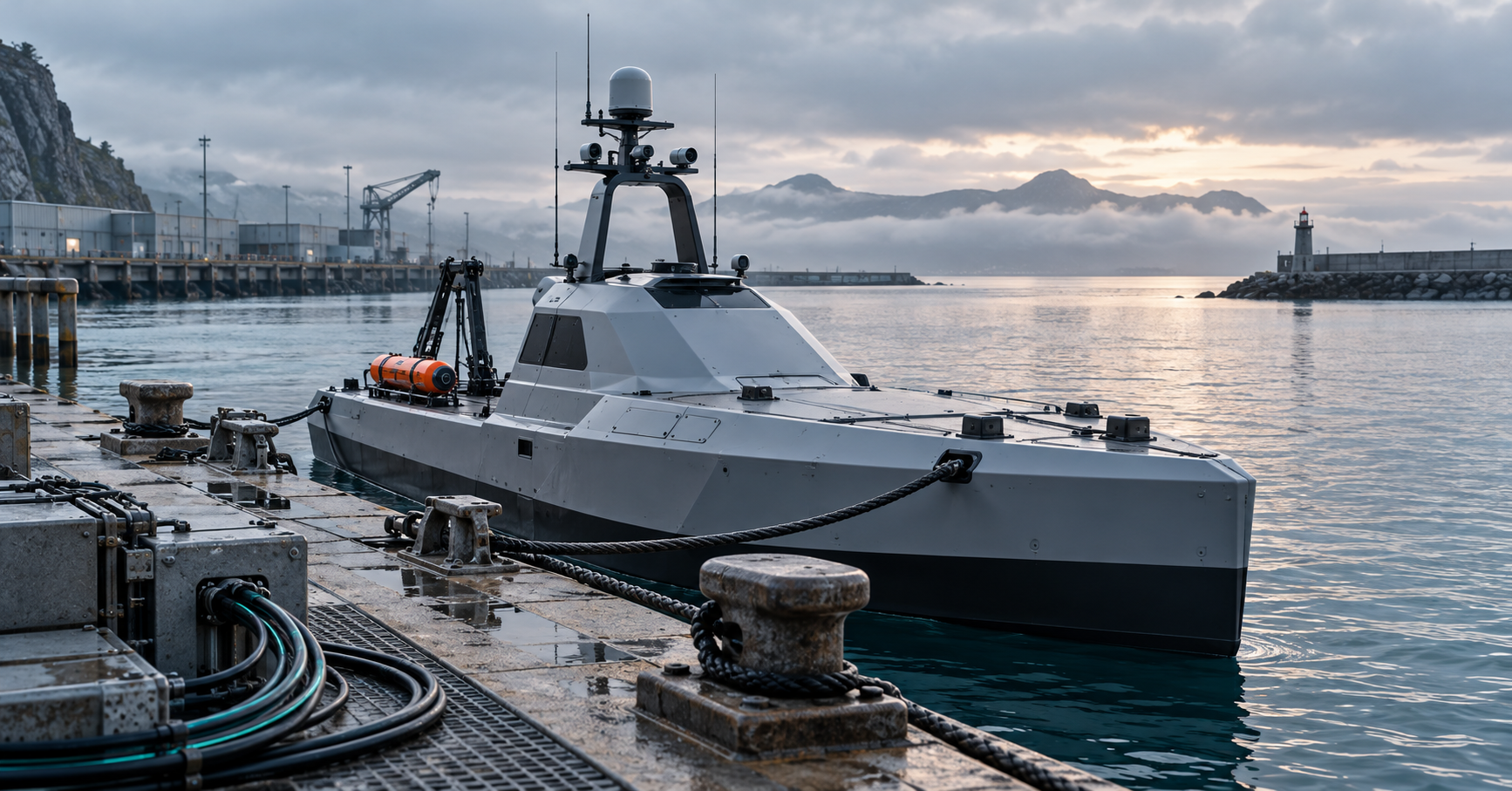
Exail makes maritime drones, including systems used to detect and neutralise underwater mines, and navigation equipment that helps vessels and other platforms determine their position and orientation. Its activities also include photonics, which uses light for applications such as sensing and communications.
Today’s group took shape when ECA Group and iXblue combined in 2022. ECA brought robotics and systems integration; iXblue contributed navigation, positioning and related technologies. The businesses already worked together, with ECA incorporating iXblue equipment into its mine-countermeasures systems.
Why Thales wants the business
A maritime robot needs to navigate, perform its mission and return usable information. Combining the vehicle, navigation equipment and systems expertise gave Exail more control over the complete offering. It also retained the ability to sell individual components to customers building their own platforms.
That second route broadens the market. Exail’s inertial navigation systems provide navigation information independently of satellite signals, supporting operations underwater and where satellite reception is disrupted. Demand therefore extends beyond customers purchasing Exail’s complete robotic systems.
In its July acquisition announcement, Thales identified underwater warfare and inertial navigation as areas it wanted to expand. It forecast an annual adjusted operating-profit contribution exceeding €90 million from revenue and cost synergies by 2032. Delivering that forecast will require additional sales, integration and cost savings over several years.
Exail’s appeal consequently includes both its existing products and the opportunity to sell them through a larger group. The financial return will also depend on the capital needed to acquire the business, address its existing obligations and support further production growth.
How ICG became part of the acquisition economics
ICG, the investment firm, helped finance the iXblue acquisition through bonds and preferred shares in Exail Holding, an unlisted subsidiary. The bonds represent lending to the business. The preferred shares carry additional economic and contractual rights that affect the amount required to buy out ICG.
Other investors hold interests in Exail’s subsidiaries too. Under the arrangements described in Exail’s June 11 refinancing disclosure, an ICG exit triggers liquidity rights for minority shareholders, allowing them to sell interests using the same underlying valuation. The cost of refinancing therefore depends partly on how the subsidiary is valued.
Exail commissioned Sorgem Evaluation to assess that value using several methods. Its work indicated approximately €580 million for the ICG exit and €130 million for other minority shareholders, or about €710 million combined. ICG favoured using the listed parent’s share price as the principal reference for valuing Exail Holding.
Exail estimated that applying ICG’s approach would produce a combined payment of approximately €1.1 billion. It reported a difference of around €380 million between the competing estimates; the published totals are rounded. These were estimates discussed in June as part of the refinancing process, with the contractual framework providing for a valuation process involving investment banks if negotiations reached a deadlock.
The disagreement shows how the financing used to build a business can influence the distribution of its subsequent growth. As the business becomes more valuable, investors with rights linked to that value can become more expensive to buy out. For Exail, the valuation method affects the funding needed to complete those exits.
What the revised liabilities represent
The proposed change of ownership prompted Exail to review the agreements established around the iXblue acquisition. Its accounting appendix explains that ICG holds enhanced dividend rights under specified circumstances and can acquire a right to require the purchase of its securities if those dividends are unpaid. Exail’s revised accounting recognises an obligation arising from these rights, whose exercise had previously been considered unlikely.
The €329 million carrying amount reflects that contractual mechanism. ICG’s bonds are recorded separately, while purchasing all its securities requires a settlement valuation. The June exit estimates cover that broader buyout process.
The €126 million employee liability comes from share plans at Exail SAS, formerly iXblue. When the business was acquired, the plans were maintained alongside settlement arrangements that included share repurchase commitments. The revised analysis treats those arrangements together as cash-settled compensation, with a liability reflecting the instruments’ value and the portion of the vesting period completed.
This gives the employee figure a clear economic basis: employees hold rights connected to shares in the acquired business, and the group has obligations associated with settling those rights. The balance can change as the instruments’ value and vesting progress change.
For public shareholders, the revised accounts improve visibility into claims attached to the operating business. They also raise a reporting issue, since some obligations had previously been unrecognised or understated. The correction allows those claims to be assessed alongside the earnings generated by the assets they helped finance.
Growth continues, with large contracts influencing comparisons
Exail’s first-half operating release reported approximately €275 million of revenue, up 25% on a reported basis and 27% organically. Navigation and Maritime Robotics accounted for most of the sales.
| First-half 2026 revenue | € million |
|---|---|
| Navigation & Maritime Robotics | 226 |
| Advanced Technologies | 58 |
| Intra-group structure and eliminations | −9 |
| Consolidated revenue | 275 |
The combined structure and eliminations line reconciles the rounded segment figures to consolidated revenue. Exail’s mix produces different commercial rhythms: equipment orders across customers and applications, alongside larger robotics programs whose award and delivery schedules can move results between periods.
First-half order intake was €228 million, compared with €612 million a year earlier. The earlier period included a roughly €400 million mine-countermeasures contract. Excluding that award gives an approximate comparison of €212 million, against which the latest intake was around 8% higher.
That comparison helps explain the reported 63% decline in orders. A large program can support deliveries over several years, allowing revenue to rise as work progresses on earlier awards. Sustaining growth eventually requires new contracts to replace the work being delivered.
There is also a funding requirement during that progression. Inventory, engineering and production capacity must be available before Exail receives all the customer payments associated with a program. The pace of collections therefore influences how much expansion the business can finance internally.
Connecting operating earnings, the net loss and cash flow
Exail’s October results reported €63 million of current EBITDA and an €87 million consolidated net loss. Current EBITDA is its adjusted operating measure, excluding depreciation, amortisation and specified expenses, including share-based payments.
The following reconciliation shows how financing and other charges enter the consolidated result.
| First-half 2026 reconciliation | € million, rounded |
|---|---|
| Current EBITDA | 63 |
| Depreciation, amortisation and provisions | −17 |
| Income from ordinary activities | 46 |
| Other operating charges | −69 |
| Operating loss | −23 |
| Net financial expense | −69 |
| Tax benefit | +6 |
| Consolidated net loss | −87 |
Figures are independently rounded. The detailed accounts reconcile an operating loss of €23.150 million, net financial expense of €69.241 million and a tax benefit of €5.549 million to the €86.842 million consolidated loss.
Compensation-related expenses account for much of the other operating charges. Financial expenses include changes in the value of obligations associated with ICG and employee instruments. This explains how progress in manufacturing and deliveries can coexist with a consolidated loss: the earnings calculation also captures the costs attached to the group’s financing and ownership arrangements.
Cash flow provides a further view of performance. Exail recorded €29.8 million of operating cash outflow during the half-year as working-capital requirements increased by approximately €68 million. Capital expenditure required another €25 million.
The company subsequently reported collecting a €117 million invoice in October. That receipt illustrates the effect of program billing and collection schedules on cash balances. For the acquisition assessment, the relevant pattern is how reliably completed work converts into customer payments across successive reporting periods.
The path from the family stake purchase to the public offer
The July 30 agreement sets out a two-stage acquisition. Thales first plans to acquire the Gorgé family’s 35.51% stake, with completion expected by the third quarter of 2027, subject to regulatory approvals. It would then launch a mandatory offer for the remaining shares and the company’s ODIRNANE bonds, with completion expected by early 2028 at the latest. The proposed consideration for ordinary shareholders is €134 per share.
ODIRNANE refers to Exail’s undated securities that can be converted or exchanged into shares. Their inclusion adds another class of security to the transaction process, alongside the ordinary shares.
For ordinary shareholders, the announced price provides a reference point, while the timetable determines how long capital remains invested before potential payment. Exail’s standalone performance also remains relevant throughout that period. Continued growth and cash collection support the business’s value if completion takes longer or the transaction fails.
The outstanding financial detail is how the subsidiary-level rights held by ICG and other investors will be settled as the acquisition proceeds. Those arrangements influence the transaction’s funding requirements and the allocation of value among security holders. Subsequent documentation should provide greater clarity on their treatment.
Operating updates and regulatory decisions will supply the other pieces: whether deliveries continue to generate cash and whether the acquisition advances on schedule. Exail also said on October 9 that its auditors’ limited review was being finalised, with the report to follow. Together, these disclosures will allow shareholders to judge progress from an agreed industrial combination toward a completed transaction.
This material is provided for informational and educational purposes only and does not constitute investment advice or a recommendation to buy or sell any security.
About AER Insights
Alliance Equity Research publishes timely insights on company-specific developments, industry trends, capital markets activity, and emerging investment themes across global public markets, with a particular focus on undercovered companies, sectors, and developments that often receive limited attention from mainstream financial research. Our analysis focuses on the financial, strategic, and valuation implications behind the headlines, using company disclosures, filings, market data, and sector context to help investors understand what matters, why it matters, and what to watch next.
Get AER Insights by Email
Receive new AER Insights and research updates in your inbox.
Related Insights
 Mining & Critical Minerals
Caledonia’s Lower Gold Guidance Still Requires a Sharp Fourth-Quarter Recovery at Blanket
Caledonia has reduced its 2026 production outlook and raised unit-cost guidance after equipment and processing problems at Blanket. The revised target still assumes a fourth-quarter recovery, while deferred capital expenditure provides near-term cash relief without reducing the underlying investment requirement.
 Biotechnology & Healthcare
Viatris’s Pacira Deal Buys Established Pain Medicines, but Growth Must Justify the Price
Viatris’s $1.65 billion cash offer adds two marketed non-opioid pain medicines and a U.S. commercial platform. The investment case depends on product durability, international expansion and cash returns, with Pacira’s debt, recent divestiture and adjusted earnings complicating a simple acquisition-multiple comparison.
 Technology & Semiconductors
Wolfspeed’s $1.5 Billion Government Loan Comes With a $750 Million Capital Test
The conditional 30-year facility could replace high-cost first-lien debt and fund U.S. silicon carbide and gallium nitride capacity. Yet no loan has closed, later draws require commercial milestones, and Wolfspeed must provide at least $750 million of qualifying capital while issuing warrants.
 Technology & Semiconductors
Xanadu’s GlobalFoundries Partnership Moves Quantum Computing Toward Manufacturing, With Economics Still Unproven
A 300 mm foundry partnership addresses the production of photonic chips and detectors needed for Xanadu’s planned quantum systems. The investment case now depends on translating component performance into manufacturing yields, integrated demonstrators and commercially useful machines while controlling development spending.